Facing the future: TVN on its technical services for the new Bundesliga season with remote production and all the bells and whistles By Heather McLean
Monday, September 29, 2025 - 11:15
Print This Story
TVN has worked alongside the Deutsche Fu ball Liga (DFL) and its host broadcast production company, Sportcast, for many years on Bundesliga and Bundesliga 2. This year is is taking some match productions for Bundesliga 2 remote for the first time
German technical services provider, TVN, has worked alongside the Deutsche Fu ball Liga (DFL) and its host broadcast production company, Sportcast, for many years on Bundesliga and the country's second division men's game, Bundesliga 2.
2025 marks the beginning of a new four year rights cycle in which the DFL has made significant changes to its rights packages. This season also heralds Germany's first top tier remote production OB going into action as TVN launches the country's first high end truck designed to bring a smaller carbon footprint to Bundesliga 2.
SVG Europe caught up with TVN Live Production's head of sales, Bastian Berlin, to find out more.
Berlin comments on the initial frenzy of activity that the start of a new rights cycle triggers for TVN: The situation is that we are now starting a new rights situation of four years so these recent weeks are really busy because there are so many new aspects. The schedule for every match day has also been adjusted. Our colleagues are doing [matches] every weekend so they know what to do in the stadium. But in these first few weeks, we have to focus even more on each individual production because of the new operations.
So this is a challenge [at this point] in the new season, to get these things working automatically. I'm sure in two months everything will be running smoothly and everyone will know what to do in which stadium for which package they've booked.
TVN and Sportcast crew working on the new season of the Bundesliga
Going remote
On the workflow for TVN each weekend as it runs between Bundesliga and Bundesliga 2 matches for Sportcast, the OB firm uses the majority of its trucks, and is soon to start using a new truck that has been built specifically for remote production.
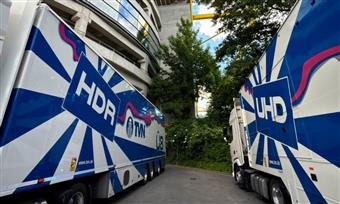
TVN has launched the first high grade remote broadcast OB truck in Germany. Although remote production does happen in Germany, it is not generally used for big league, high tier sports. TVN has created a remote truck workflow where the truck goes to site, signals from the location are sent to TVN's technical centre in Hanover, and the gallery is situated at TVN's new remote operation centre in Cologne.
The first time the truck was used was 13 September in a remote production for Bundesliga 2. The new remote workflow will be used for the second division primarily, with a move to do a Bundesliga game, not happening the next five years to use the remote setup for the really big matches, notes Berlin.
Berlin comments: We have 10 trucks in total [at TVN] and for the Bundesliga and the second division, we use seven trucks per weekend, and in the future that will change to six trucks and one remote unit. We just built up the remote unit here and we will use it starting from sometime in September.
He continues: For the second division where we are working with a ten camera standard, and the unilateral packages are not that complex and large, it is a perfect setting [to work remotely], he says. The workflow is as follows: our venue OB van is placed at the stadium with the cameras, with the shading areas, and the signals will be transmitted to our technical centre here in Hanover at TVN, and the gallery with the director and the slomo operators is based in Cologne in the remote operation centre. It is really nice to see how it is working. We have less than 50 milliseconds delay, so it is really fast. It's really quite cool.
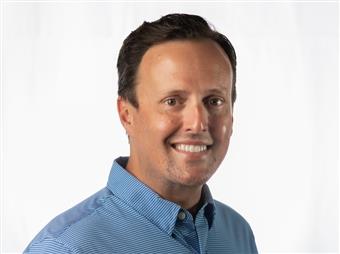
TVN Live Production's head of sales, Bastian Berlin
Facing the future
Berlin says that lower tier sports that do not require the highest broadcast standard are the only sporting areas currently covered with remote production in Germany at the moment: In Germany we have some other companies who are doing remote solutions, but it's a different version for small sports with a higher [latency] delay, and not in the most complex way, because of course there are some markets where you can do it more efficiently because the production is more simple with three or four cameras.
He continues: Our [remote production] project for the second division is the first one [in Germany] for high tier sports production. We are starting with remote productions, but to be honest, currently it is not really any more cost effective than doing it with [a regular] OB truck, but we do have less people on site, and it offers many advantages for the future.
On the benefit for TVN and for its crew of being able to work remotely, Berlin adds: Having seven or eight trucks on the street every weekend, of course a lot of people are working at the weekends for us. It is a good thing if we can offer working space here in Hanover; some colleagues like to be in the technical centre here for a remote production from nine to seven, and then go home without having to travel every weekend. So also for our employees remote offers another option for working.
As to why TVN which is one of the largest technical services providers in Germany has only just now got into the remote production game, Berlin explains.
Honestly in Germany one issue is the fibre topic, because fibre is less available in Germany compared to other European countries, both for private houses and also not for broadcast. And, of course, it is also a cost factor.
Yet Berlin says that despite the lack of a strong business case for doing remote production for premier sports in Germany, it is stil
More from Sports Video Group
05/12/2025
2025 Sports Broadcasting Hall of Fame: Curt Gowdy Jr. - Master Storyteller, Nati...
05/12/2025
SVG Sit-Down: Veritone's Sean King on the Power of Mining Video, Audio DataThe company's Data Refinery offers users total control and governance over da...
05/12/2025
Platinum White Paper: Inside the Nashville Predators' Unified, Flexible, Sca...
05/12/2025
Netflix Reaches Agreement To Acquire Warner Bros. Following Planned WBD SplitThe deal does not include WBDs sports assets like TNT Sports (US, UK, LatAm), Euros...
05/12/2025
FOX Sports Returns to Indianapolis for Primetime Broadcast of Big Ten Championsh...
05/12/2025
SVG Summit 2025 Preview: Digital Engagement & Monetization Workshop Tackles the ...
05/12/2025
Atlanta United Lights Up New Emory Healthcare Studio With First Live Broadcast f...
05/12/2025
As Messi Takes the Pitch, MLS, Apple, NEP Roll Out Largest MLS Cup Production Ev...
05/12/2025
ESPN Enters College Football's Most Intense Month With Elevated Workflows fo...
04/12/2025
SVG Sit-Down: ProximaVision's Claudio Lisman on Why Tethered Drones Could Be...
04/12/2025
SVG Campus Shot Callers: Imry Halevi, Senior Associate Director of Athletics, Co...
04/12/2025
Platinum White Paper: LiveU Lightweight Sports Production: A Step Change in Spor...
04/12/2025
London to Riyadh: DAZN brings the boxing glamour to new production levels for Be...
04/12/2025
Analysis: Paramount bets on the battering ram' with Champions League play By Callum McCarthy, Editor-at-Large
Tuesday, December 2, 2025 - 10:12
Print ...
04/12/2025
Space City Home Network Launches SCHN DTC App for Astros and RocketsThe Rockets and Astros were previously the lone NBA and MLB teams without a DTC appBy Jason...
04/12/2025
SVG Summit 2025 Preview: Content Workflows Workshop Spotlights Evolution of Spor...
04/12/2025
New Sponsor Spotlight: Geotech's Patrick Wambold On the Unreal Engine Revolu...
04/12/2025
Curt Gowdy Jr. - Master Storyteller, Nationally and RegionallyBy Jason Dachman, Editorial Director, U.S.
Thursday, December 4, 2025 - 1:52 pm
Print This Sto...
03/12/2025
MLS Cup 2025 Production To Feature Four iPhone 17 Pros as Game-Coverage CamerasStay tuned to SVG on Friday for our in-depth story on this year's MLS Cup pro...
03/12/2025
SVG LIVE! 2025: All Sessions Now Available to Watch on SVG PLAYThe inaugural event placed a spotlight on the exciting world of live entertainmentBy SVG Staff
...
02/12/2025
Case Study: How Mid-Atlantic Sports Network Moved to All-IP Distribution in 60 D...
02/12/2025
2025 Sports Broadcasting Hall of Fame: Lee Corso, Coach, Commentator, FirebrandBy Ken Kerschbaumer
Tuesday, December 2, 2025 - 7:00 am
Print This Story | S...
02/12/2025
SVG All-Stars: Dan Nabors, Senior Director, Remote Engineering, TNT SportsThe veteran tech leader is helping guide Warner Bros. Discovery's at-home' re...
02/12/2025
Epic rematch: DAZN on bringing Eubank Jr v Benn II to spectacular life with 1080...
02/12/2025
National Lacrosse League Opens Season With New Cloud-Based Official Replay-Revie...
02/12/2025
Platinum White Paper: The Cinematic Look in Live Production - Bridging Aesthetic...
02/12/2025
SVG India Announces Advisory Board; JioStar's Prashant Khanna Named ChairmanBy Ken Kerschbaumer
Tuesday, December 2, 2025 - 11:15 am
Print This Story |...
02/12/2025
SVG Summit 2025 Preview: New AI Production Tools Workshop' Features ESPN, F...
26/11/2025
SVG Sit-Down: Prime Video EP Mike Muriano Previews Massive Black Friday Slate Fe...
25/11/2025
SVG All-Stars: Blayke Scheer, Senior Director, Creative Content, YES NetworkThe Indiana alum has turned storytelling into an artform for more than two decadesBy...
25/11/2025
Op-Ed: With FCC's C-Band Auction on the Horizon, Broadcasters Need Proven, C...
25/11/2025
Analysis: Is Baller League really the future of sport? By Callum McCarthy, Editor-at-Large
Tuesday, November 25, 2025 - 10:10
Print This Story
With KSI on...
25/11/2025
Platinum Whitepaper: The Growth of Broadcast in the World of Major Large Scale E...
25/11/2025
SVG Summit 2025 Preview: SVG Women's Sports WorkshopBy Samantha Gabay
Tuesday, November 25, 2025 - 10:27 am
Print This Story | Subscribe
Story Highlig...
25/11/2025
SVG New Sponsor Spotlight: CacheFly's Matt Levine on the Evolving Role of th...
25/11/2025
Peacock's EA SPORTS Madden NFL Cast Levels Up on Thanksgiving With SkyCam as...
24/11/2025
HBO's The Shuffle' Reveals Longtime Connection of Sports and Entertainm...
24/11/2025
2025 Sports Broadcasting Hall of Fame: Hiroshi Kiriyama, Sony Broadcast (and Ind...
24/11/2025
SVG Summit 2025 Preview: FIFA, NBC Olympics, Fox Sports, CBS Sports, Netflix, NF...
24/11/2025
Case Study: YES Network Streamlines Broadcast Operations with Beam DynamicsBy SVG Staff
Monday, November 24, 2025 - 11:18 am
Print This Story | Subscribe
...
24/11/2025
Platinum White Paper: More of Everything: How Broadcasters are Changing Their Ap...
24/11/2025
Versant Media USA Sports President Matt Hong on How Versant Has Best of Both Wor...
24/11/2025
SVG Sit-Down: NABA Director-General Rebecca Hanson on How FCC's C-Band Aucti...
24/11/2025
SVG New Sponsor Spotlight: Bolin Technology's Sapan Doshi on the Proliferati...
21/11/2025
Platinum White Paper: Appear Shares Why Media Exchange Is the Missing Link in So...
21/11/2025
NWSL Championship 2025: CBS Sports To Deploy Two-Point FlyCam for Match Coverage...
21/11/2025
NWSL Caps 2025 Season With Awards Show, Skills Challenge ProductionsA team of 70 is on the ground in California to produce both eventsBy Mark J Burns, SVG Contr...
21/11/2025
USL and NEP Ready for Largest USL Championship Final Production EverThe broadcast from Tulsa, OK, will air CBS and TUDN on Saturday at 12 p.m. ETBy Jason Dachma...
21/11/2025
With Two New Teams, PWHL Boosts Production Workforce and Central Review for Seas...
20/11/2025
MLB Media-Rights Shakeup: NBC's New Three-Year Deal Covers Sunday Night Bas...














 Facing the future: TVN on its technical services for the new Bundesliga season with remote production and all the bells and whistles By Heather McLean