Experimental HIV vaccine achieves a long-sought goal In a first for the field, all non-human primates given a new series of vaccines generated antibodies capable of fighting multiple strains of HIV.
May 28, 2026
LA JOLLA, CA For years, researchers have been hoping for vaccines that protect people against not just one strain of HIV, but every strain of the quickly mutating virus. This requires a vaccine that coaxes the human body to develop something called broadly-protective antibodies molecules that recognize a broad range of HIV strains.
Now, scientists at Scripps Research and Swedens Karolinska Institute have developed an experimental vaccine that leads to broadly protective HIV antibodies in every rhesus macaque tested.
The finding, published in Nature on April 29, 2026, marks the first time vaccination alone has produced this reliable outcome and brings researchers closer to a vaccine effective against the vast diversity of HIV strains circulating worldwide.
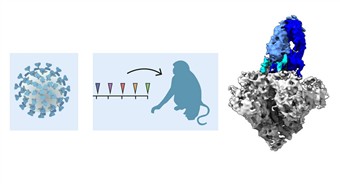
The new vaccine targets a part of the HIV virus that rarely changes between strains the tip, or apex, of HIV's outer spike protein. The spike is the only part of HIV that is exposed on its surface and is responsible for its interactions with human cells. In six non-human primates, the vaccine against the spike apex led to antibodies that had activity against HIV strains the animals hadn't previously been exposed to.
This has been a long time coming, says senior author Richard Wyatt, a professor at Scripps Research. The fact that we see this response in all our animals tells us that we're on to something. It's better than we could have hoped for and incredibly gratifying.
HIV mutates so rapidly that most immune responses in the human body cannot keep pace; by the time antibodies develop against one strain, the virus has mutated to evade them. A minority of people living with HIV do eventually develop broadly neutralizing antibodies (bnAbs): immune proteins that can block a wide range of strains because they recognize unchanging bits of HIV. But translating this response into a vaccine has proven difficult.
Wyatt's lab has spent more than a decade developing an approach that lets them create virus-sized nanoparticles studded with hundreds of copies of HIV's outer spike protein, called the Env trimer (in other words, a particle that looks like the HIV virus without causing disease). By varying which spike proteins are loaded onto the nanoparticles, the team can trigger different antibodies. Last year, using one version of this platform, Wyatt and his team showed that vaccinated macaques could develop bnAbs against the CD4 binding site, a critical spot where HIV's spike interacts with human immune cells.
In the new work, they turned their attention to one of the virus' other vulnerable regions: the apex of the spike. This site sits at the very top of the Env trimer and stays nearly identical across most of the hundreds of thousands of HIV strains in circulation.
The apex is a very desirable vaccine target for two reasons, says Scripps Research senior staff scientist Javier Guenaga, co-first author of the study. It's highly conserved across all HIV strains, and very potent bnAbs from people living with HIV have been previously isolated.
To create a vaccine that could reliably elicit these broad-acting antibodies against the apex, the researchers first had to find the right starting immunogen. Not all HIV spike proteins are equal when it comes to training the immune system; only some coax the immune system to create the rare immune cells that eventually give rise to apex-targeting bnAbs. So, the team first screened a library of stabilized HIV spike proteins to find ones that could recognize and activate those particular cells. Then, they used those spike proteins in their nanoparticle design.
When the group vaccinated six non-human primates with a series of these vaccines beginning with a spike protein identified as the best priming candidate and then boosting with spike proteins from other HIV strains all six animals developed apex-targeted cross neutralizing antibodies. Electron microscopy confirmed that the antibodies produced in the vaccinated animals bound to the spike's apex in the same way as bnAbs isolated from humans living with HIV and had activity against multiple genetically distinct HIV strains they had never been exposed to. That activity, against wild HIV strains and not just ones in the vaccine, is known as tier-2 cross-neutralization.
Tier-2 cross-neutralization is the benchmark in the field, and we achieved it in every animal, says Scripps Research senior staff scientist Shridhar Bale, co-first author of the study. When we got those results, it was really a wow' moment. We want the broader field to appreciate what has been achieved here.
The experimental vaccines aren't yet ready for testing in humans; manufacturing clinical-grade versions of the nanoparticles is technically demanding and costly. The team is exploring other ways to deliver spike proteins that could elicit the same responses, including mRNA vaccines. Ultimately, a fully protective HIV vaccine will likely need to target the apex at the same time as other vulnerable sites on the spike such as the CD4 binding site.
The field has made more progress in the last few years than in the previous 30 combined, says Wyatt. So now is the time to push forward with funding and research. We're eager to get this translated to humans.
In addition to Wyatt, Guenaga and Bale, authors of the study, Vaccination generates broadly cross-neutralizing antibodies to the HIV Env apex, include Swastik Phulera, Sashank Agrawal, Miyo Ota, Richard Wilson, Jocelyn Cluff, Tamar Dzvelaia, Wen-Hsin Lee, Agnes A. Walsh, Mariane Melo, Darrell Irvine, Ian Wilson, Andrew Ward and Gabriel Ozorowski of Scr
More from Scripps
13/08/2026
Scripps Research has established the Peter K. Vogt Endowed Chair, a new faculty ...
13/08/2026
LA JOLLA, CA-A vaccine's molecular structure plays a key role in determining how the immune system responds and prepares to protect the body from future exp...
12/08/2026
LA JOLLA, CA-Scientists at Scripps Research have discovered that two seemingly unrelated cellular enzymes become locked together during times of stress, simulta...
06/08/2026
LA JOLLA, CA-Scripps Research has received more than $500,000 in first-year fund...
06/08/2026
LA JOLLA, CA-Viruses are masters at invading our cells thanks to specialized proteins that coat their surfaces. When scientists design vaccines, they often crea...
06/08/2026
LA JOLLA, CA-The brain has its own immune system, which detects threats and mounts a defense. A growing body of evidence has shown that in Alzheimer's disea...
06/08/2026
LA JOLLA, CA-Scripps Research chemist Jin-Quan Yu has been elected to the National Academy of Sciences (NAS), one of the highest honors a scientist can achieve....
06/08/2026
LA JOLLA, CA-Scripps Research ranked third in the inaugural 2026 Cure Innovation Index recognizing the top-performing institutes and centers across the United S...
06/08/2026
Benjamin Cravatt, the Gilula Chair of Chemical Biology and a professor of chemis...
06/08/2026
LA JOLLA, CA-Dennis Burton, professor and the James & Jessie Minor Chair in Immu...
06/08/2026
LA JOLLA, CA-Inside every human cell, proteins are constantly being tagged with small chemical modifications after they're produced. Known as post-translati...
06/08/2026
LA JOLLA-Scripps Research has established the Ian Wilson Endowed Chair, a new fa...
06/08/2026
Scripps Research's Skaggs Graduate School of Chemical and Biological Science...
06/08/2026
LA JOLLA, CA-Professor Jin-Quan Yu of Scripps Research has been elected to the Fellowship of the Royal Society, the U.K.'s national academy of sciences and ...
06/08/2026
LA JOLLA, CA-For years, researchers have been hoping for vaccines that protect people against not just one strain of HIV, but every strain of the quickly mutati...
06/08/2026
LA JOLLA, CA-The Calibr-Skaggs Institute for Innovative Medicines, the nonprofit...
06/08/2026
LA JOLLA, CA-Building the complex 3D molecules needed for new medicines has alwa...
06/08/2026
LA JOLLA, CA-Fentanyl and related variants of the synthetic opioid kill more Americans each year than car accidents and gun violence combined. In too-high doses...
06/08/2026
LA JOLLA, CA-What do decoding communication between organs and reimagining the future of genome editing have in common? They're among the scientific questio...
06/08/2026
LA JOLLA, CA-Of the 1.2 million people living with HIV in the United States, app...
06/08/2026
LA JOLLA, CA-For some people, cancer immunotherapies are life-changing. These treatments can turn the body's own immune system against a tumor, either elimi...
06/08/2026
LA JOLLA, CA-Many conditions that cause vision loss share a common feature: the ...
06/08/2026
LA JOLLA, CA-RNA interference is a natural mechanism for living cells to control whether specific genes are being used or not.
Crowned with the 2006 Nobel Priz...
06/08/2026
LA JOLLA, CA-The drugs that keep rheumatoid arthritis in check may one day help people stop drinking. A new Scripps Research study shows that an anti-inflammato...
06/08/2026
LA JOLLA, CA-Antibiotic resistance is one of the most urgent threats to global health, linked to an estimated 4.7 million deaths worldwide in 2019 alone. As mor...
06/08/2026
LA JOLLA, CA-Some of the world's best-selling diabetes drugs depend on a che...
06/08/2026
LA JOLLA, CA-Detecting infectious disease threats early and responding quickly can dramatically alter the course of an infectious outbreak. Technologies such as...
06/08/2026
LA JOLLA, CA-Molecular biophysicist Joan Pulupa will join Scripps Research in Ja...
06/08/2026
LA JOLLA, CA-HIV is globally so diverse, consisting of hundreds of thousands of ...
07/07/2026
Scripps Research scientists train the immune system to make antibodies against numerous HIV strains Preclinical findings mark progress toward a long-sought vacc...
03/07/2026
Scripps Research scientists awarded $2M to advance global disease surveillance Two Gates Foundation grants will expand wastewater surveillance and AI-driven dis...
03/07/2026
Joan Pulupa joins Scripps Research faculty to study the organization of DNA in brain cells and its links to neurodegeneration Using smell-sensing neurons and ad...
30/06/2026
Scripps Research scientists demonstrate a faster, cheaper route to making critical drugs using common table sugar New method illustrates how to build a tough ch...
25/06/2026
Immune molecule may drive excessive drinking in alcohol use disorder Scripps Research scientists showed that blocking an immune molecule tied to inflammation r...
23/06/2026
Newly identified molecule strengthens the eye's response to damage in retinal disease Scripps Research discovery finds that restoring the naturally occurrin...
19/06/2026
Lab studies explain how new cancer drug works as it enters patient testing Immunologists at Scripps Research show how a new, experimental drug revives immune ce...
17/06/2026
Calibr-Skaggs awarded $5.1M by NIH to develop long-acting hepatitis B virus therapy A new program aims to replace a daily HBV drug with once-monthly or even qua...
12/06/2026
A fentanyl countermeasure that adapts to combat future black-market drugs Scripps Research scientists developed a vaccine that teaches the immune system to rapi...
10/06/2026
Chemists snap together complex 3D molecules from highly reactive radicals-without losing their shape Scripps Research team develops stereoretentive radical-radi...
29/05/2026
Experimental HIV vaccine achieves a long-sought goal In a first for the field, all non-human primates given a new series of vaccines generated antibodies capabl...
28/05/2026
Scripps Research's Skaggs Graduate School awards doctoral degrees to 34th graduating class
May 21, 2026
Scripps Research's Skaggs Graduate School of ...
28/05/2026
Scripps Research chemist Jin-Quan Yu is named a Fellow of the Royal Society Yu is honored by the U.K.'s national academy of sciences for his work in synthet...
14/05/2026
Scripps Research establishes endowed chair honoring renowned structural biologist Ian Wilson Keren Lasker to be inaugural chair holder
May 13, 2026
LA JOLLA ...
06/05/2026
How changes to proteins can alter drug interactions for new precision therapies Scripps Research team maps how chemical modifications to proteins affect drug bi...
02/05/2026
Scripps Research immunologist Dennis Burton elected to American Academy of Arts and Sciences A leader in broadly neutralizing antibodies, Burton has helped driv...
30/04/2026
Scripps Research ranks third in 2026 Cure Innovation Index
April 29, 2026
LA JOLLA, CA Scripps Research ranked third in the inaugural 2026 Cure Innovation In...
29/04/2026
Jin-Quan Yu elected to the National Academy of Sciences Yu is recognized for his pioneering work in synthetic organic chemistry.
April 28, 2026
LA JOLLA, CA S...
11/04/2026
NIH expected to award Scripps Research nearly $4.2 million over 5 years to advance tools for vaccine design Funding will expand methods for studying viral prote...
09/04/2026
New technique for synthesizing branched molecules could accelerate the development of future medicines Scripps Research chemists solve a longstanding problem in...
08/04/2026
Scripps Research scientists uncover new mechanism cancer cells use to survive DNA damage Discovery reshapes understanding of how tumor cells repair broken DNA, ...














 Experimental HIV vaccine achieves a long-sought goal In a first for the field, all non-human primates given a new series of vaccines generated antibodies capable of fighting multiple strains of HIV.