LA JOLLA, CA-A vaccine's molecular structure plays a key role in determining how the immune system responds and prepares to protect the body from future exposure to a specific pathogen. To develop a vaccine that offers long-term protection from HIV, it's essential to promote a long-lasting immune response, where immune cells and antibodies prepared to combat the virus persist within the body. This has inspired scientists to find ways to alter vaccine structure to increase the duration and persistence of the immune response.
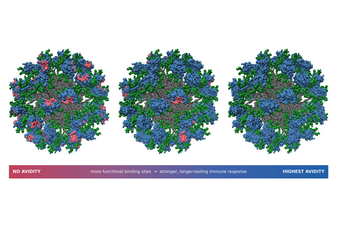
Now, in a pair of preclinical studies each published in Science Translational Medicine on August 12, 2026, scientists across Scripps Research, the University of Texas Medical Branch and IAVI found that increasing the avidity -or overall binding strength-of vaccine nanoparticles to specific white blood cells promotes stronger and more durable immune responses in mice.
The first study examined how avidity affects the durability of the immune response, while the second study looked at how avidity influences which immune cells are most successful during that response. By demonstrating how higher overall binding strength could improve immune performance, these findings may help researchers design the next generation of vaccines for HIV and other infectious diseases.
We're trying to dial all the knobs we can in terms of vaccine design to get the strongest possible immune responses to stop HIV, says the co-senior author of both studies, Scripps Research professor William Schief, who's also the vice president of protein design in infectious disease research at Moderna, Inc. and an executive director of vaccine design at IAVI's Neutralizing Antibody Center. Both of these papers show that nanoparticles with higher overall binding strength lead to stronger immune responses at basically every stage of the overall response. This makes overall binding strength a promising aspect to explore to make better vaccines.
Previous work led by Schief and his colleagues demonstrated the ability to produce mature, functional broadly neutralizing antibodies that block many different HIV strains from infecting cells in non-human primates. The researchers believed that a key to success in this prior study was the use of a nanoparticle at the last vaccination. But the study did not look at the durability of the immune response or how to optimize it. Schief's team suggested that increasing overall binding strength of the nanoparticles may be one way to do so.
In particular, the new studies looked at how strongly a vaccine nanoparticle binds to the intended precursor B cells-white blood cells that can mature into cells that release antibodies-within the body. This overall binding strength combines two factors: the repetitiveness and the binding strength of individual B cell attachment points within a single nanoparticle. Historically, it's been difficult to tell the relative impact of each of these features in determining the overall binding strength.
Schief and his team had some tricks up their sleeves to deconstruct the specific contributions of repetitiveness and attachment point binding strength, using carefully engineered vaccine nanoparticles.
Members of Schief's lab engineered a set of six types of vaccine nanoparticles with a range of repetitiveness: the most repetitive had 60 functional attachment points, while the least had zero. They were able to keep other key factors, like nanoparticle size, constant.
With these nanoparticles in hand, Robert Abbott, an assistant professor at the University of Texas Medical Branch and co-senior author of both studies, set out to vaccinate mice with each of them, to figure out how repetitiveness influences the overall immune response at various stages. His team used mice with precursor B cells that have been adapted to bind the specific attachment point on the nanoparticles-which is designed to guide B cells to develop toward producing antibodies against HIV.
In the first study, Abbott's team found that increased attachment point repetitiveness led to a longer lasting and more durable overall immune response. This included prompting greater production and persistence of memory B cells, long-lived plasma cells and antibodies in the bloodstream-all important for long-term protection. The team also confirmed that the improved immune responses were driven by the nanoparticle's repetitive structure rather than simply an increased total number of the stimulating attachment points.
In addition to repetitiveness, the researchers assessed how attachment point binding strength affected immune responses. This was done by using an additional set of mixed repetitiveness nanoparticles engineered by Schief's lab and mice with different precursor B cells that had either medium or high binding strength to the nanoparticles. They found that while binding strength is also important in driving many of these immune responses, repetitiveness played a more dominant role.
In the second study, the researchers wanted to dig in further to understand precisely how overall binding strength alters what happens within germinal centers, the factories where activated precursor B cells mature. They found that precursor B cells that bind highly repetitive nanoparticles are preferentially allowed to mature within germinal centers compared to their counterparts that bind less repetitive nanoparticles. Higher attachment point binding strength also improved B cell success, but not to the same degree as repetitiveness.
So basically, higher overall binding strength allowed the B cells targeting that attachment point to compete better against other B cells, which is really exciting, says Christopher Cottrell, an author on both studies who is an institute investigator at Scripps Research.
Importantly, these results depended on the leve
More from Scripps
02/10/2026
LA JOLLA, CA-To sense their environment and respond accordingly, cells enlist me...
17/09/2026
LA JOLLA, CA-While the brain orchestrates metabolic processes in the body, it al...
11/09/2026
LA JOLLA, CA-Transthyretin amyloid disease (ATTR) is a progressive, life-threatening condition caused when the protein transthyretin (TTR) breaks apart and aggr...
05/09/2026
LA JOLLA, CA-In recognition of his exceptional work to understand the chemistry of carbohydrates and the role they play in health and disease, Scripps Family Ch...
02/09/2026
LA JOLLA, CA-Influenza viruses constantly shapeshift to evade recognition by the immune system. This shapeshifting occurs in critical proteins like hemagglutini...
02/09/2026
LA JOLLA, CA-Clinicians often use a medical test called a 12-lead electrocardiogram (ECG) to diagnose heart problems, which uses electrodes placed on the chest ...
02/09/2026
LA JOLLA, CA-Proteins may look like rigid molecular structures, but inside our c...
28/08/2026
LA JOLLA, CA-Scripps Research has established the Pete Schultz Fund for Innovati...
28/08/2026
LA JOLLA, CA-Chemical structures called cyclopropanols are among the most useful...
26/08/2026
LA JOLLA, CA-Recent advances in robotics, automation and artificial intelligence...
26/08/2026
LA JOLLA, CA-Jeffery Kelly, the H. Lutcher Brown Professor of Chemistry at Scrip...
20/08/2026
LA JOLLA, CA-Scripps Research assistant professor Tiantian Liu has received a five-year NIAID DP2 award from the National Institute of Allergy and Infectious Di...
18/08/2026
The relationships built during graduate school often continue to shape careers long after a degree is earned, creating a community of scientists who learn from ...
13/08/2026
Scripps Research has established the Peter K. Vogt Endowed Chair, a new faculty ...
13/08/2026
LA JOLLA, CA-A vaccine's molecular structure plays a key role in determining how the immune system responds and prepares to protect the body from future exp...
12/08/2026
LA JOLLA, CA-Scientists at Scripps Research have discovered that two seemingly unrelated cellular enzymes become locked together during times of stress, simulta...
06/08/2026
LA JOLLA, CA-Scripps Research has received more than $500,000 in first-year fund...
06/08/2026
LA JOLLA, CA-Viruses are masters at invading our cells thanks to specialized proteins that coat their surfaces. When scientists design vaccines, they often crea...
06/08/2026
LA JOLLA, CA-The brain has its own immune system, which detects threats and mounts a defense. A growing body of evidence has shown that in Alzheimer's disea...
06/08/2026
LA JOLLA, CA-Scripps Research chemist Jin-Quan Yu has been elected to the National Academy of Sciences (NAS), one of the highest honors a scientist can achieve....
06/08/2026
LA JOLLA, CA-Scripps Research ranked third in the inaugural 2026 Cure Innovation Index recognizing the top-performing institutes and centers across the United S...
06/08/2026
Benjamin Cravatt, the Gilula Chair of Chemical Biology and a professor of chemis...
06/08/2026
LA JOLLA, CA-Dennis Burton, professor and the James & Jessie Minor Chair in Immu...
06/08/2026
LA JOLLA, CA-Inside every human cell, proteins are constantly being tagged with small chemical modifications after they're produced. Known as post-translati...
06/08/2026
LA JOLLA-Scripps Research has established the Ian Wilson Endowed Chair, a new fa...
06/08/2026
Scripps Research's Skaggs Graduate School of Chemical and Biological Science...
06/08/2026
LA JOLLA, CA-Professor Jin-Quan Yu of Scripps Research has been elected to the Fellowship of the Royal Society, the U.K.'s national academy of sciences and ...
06/08/2026
LA JOLLA, CA-For years, researchers have been hoping for vaccines that protect people against not just one strain of HIV, but every strain of the quickly mutati...
06/08/2026
LA JOLLA, CA-The Calibr-Skaggs Institute for Innovative Medicines, the nonprofit...
06/08/2026
LA JOLLA, CA-Building the complex 3D molecules needed for new medicines has alwa...
06/08/2026
LA JOLLA, CA-Fentanyl and related variants of the synthetic opioid kill more Americans each year than car accidents and gun violence combined. In too-high doses...
06/08/2026
LA JOLLA, CA-What do decoding communication between organs and reimagining the future of genome editing have in common? They're among the scientific questio...
06/08/2026
LA JOLLA, CA-Of the 1.2 million people living with HIV in the United States, app...
06/08/2026
LA JOLLA, CA-For some people, cancer immunotherapies are life-changing. These treatments can turn the body's own immune system against a tumor, either elimi...
06/08/2026
LA JOLLA, CA-Many conditions that cause vision loss share a common feature: the ...
06/08/2026
LA JOLLA, CA-RNA interference is a natural mechanism for living cells to control whether specific genes are being used or not.
Crowned with the 2006 Nobel Priz...
06/08/2026
LA JOLLA, CA-The drugs that keep rheumatoid arthritis in check may one day help people stop drinking. A new Scripps Research study shows that an anti-inflammato...
06/08/2026
LA JOLLA, CA-Antibiotic resistance is one of the most urgent threats to global health, linked to an estimated 4.7 million deaths worldwide in 2019 alone. As mor...
06/08/2026
LA JOLLA, CA-Some of the world's best-selling diabetes drugs depend on a che...
06/08/2026
LA JOLLA, CA-Detecting infectious disease threats early and responding quickly can dramatically alter the course of an infectious outbreak. Technologies such as...
06/08/2026
LA JOLLA, CA-Molecular biophysicist Joan Pulupa will join Scripps Research in Ja...
06/08/2026
LA JOLLA, CA-HIV is globally so diverse, consisting of hundreds of thousands of ...
07/07/2026
Scripps Research scientists train the immune system to make antibodies against numerous HIV strains Preclinical findings mark progress toward a long-sought vacc...
03/07/2026
Scripps Research scientists awarded $2M to advance global disease surveillance Two Gates Foundation grants will expand wastewater surveillance and AI-driven dis...
03/07/2026
Joan Pulupa joins Scripps Research faculty to study the organization of DNA in brain cells and its links to neurodegeneration Using smell-sensing neurons and ad...
30/06/2026
Scripps Research scientists demonstrate a faster, cheaper route to making critical drugs using common table sugar New method illustrates how to build a tough ch...
25/06/2026
Immune molecule may drive excessive drinking in alcohol use disorder Scripps Research scientists showed that blocking an immune molecule tied to inflammation r...
23/06/2026
Newly identified molecule strengthens the eye's response to damage in retinal disease Scripps Research discovery finds that restoring the naturally occurrin...
19/06/2026
Lab studies explain how new cancer drug works as it enters patient testing Immunologists at Scripps Research show how a new, experimental drug revives immune ce...
17/06/2026
Calibr-Skaggs awarded $5.1M by NIH to develop long-acting hepatitis B virus therapy A new program aims to replace a daily HBV drug with once-monthly or even qua...














 LA JOLLA, CA-A vaccine's molecular structure plays a key role in determining how the immune system responds and prepares to protect the body from future exposure to a specific pathogen. To develop a vaccine that offers long-term protection from HIV, it's essential to promote a long-lasting immune response, where immune cells and antibodies prepared to combat the virus persist within the body. This has inspired scientists to find ways to alter vaccine structure to increase the duration and persistence of the immune response.