LA JOLLA, CA-Building the complex 3D molecules needed for new medicines has always been a bit like assembling a puzzle with pieces that keep trying to flip over. Now, chemists at Scripps Research have found a way to snap two such molecular pieces together while keeping their original 3D shapes intact, even when using some of the most reactive molecules in chemistry: free radicals.
In a study published in Science on June 4, 2026, the research team reports a new cross-coupling reaction-a way to join two carbon-based fragments into one molecule while keeping the starting 3D arrangement intact. This 3D maintenance is called stereoretention, and the method to retain it uses a simple nickel catalyst. The new reaction works across a wide range of pharmaceutically relevant molecules, offering a useful new tool for drug discovery.
Organic chemistry is fundamentally about forming carbon-carbon bonds, and doing so with control over 3D structure is one of the most important obstacles to overcome, says senior author Phil Baran, a professor and the Dr. Richard A. Lerner Endowed Chair at Scripps Research. Our approach lets us connect the most reactive pieces and still get precise results.
Many drugs work because their molecules have a specific 3D handedness (chirality) that allows them to fit into biological targets, much like a left hand only fits a left glove. The mirror-image version often does nothing-or worse, it can bind differently and cause unwanted side effects. Yet creating chiral centers while linking carbon atoms has been notoriously difficult, especially when using highly reactive radicals that normally lose their orientation almost instantly.
Traditional solutions either require many synthetic steps or expensive shape-controlling catalysts, or they force chemists to build molecules in a more linear, less efficient way. The research team's new method bypasses these limitations by letting chemists take two pre-assembled, complex fragments and join them directly.
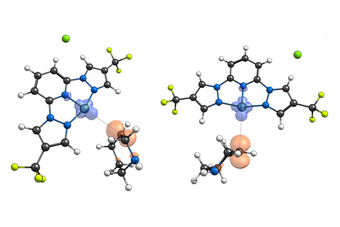
The moment after homolysis. Nitrogen gas (blue) departs from the molecule, generating the nickel-based radical complex (dark green) and the alkyl radical fragment (white and dark gray), poised for rebound. Two perspectives are shown. Credit: Scripps Research
Click here for a high-resolution image. This new reaction couples a sulfonyl hydrazide (a compound that carries the desired 3D information) that's already left- or right-handed with a common type of molecule in organic chemistry called an alkyl halide. Both generate short-lived carbon radicals, but the nickel catalyst carefully times their encounter. One radical is briefly caged on the nickel in a protected environment, allowing it to snap back and form the new bond before it can escape and scramble its handedness. This caged radical rebound is the key to preserving stereoretention while maintaining 80-96% enantiospecificity, meaning the product usually keeps its starting handedness, and producing practical yields between 40-90%.
The process is redox-neutral, so there's no need for extra chemicals to move the reaction forward. This approach also doesn't require specialized additives or shape-directing helper molecules (called chiral ligands), and it runs under standard lab conditions. Plus, it tolerates the kinds of chemical parts drug chemists rely on to build and fine-tune medicines-including free amines, olefins, heterocycles, aryl bromides and more-without unwanted side reactions.
The team demonstrated the method on dozens of starting materials, focusing on piperidine and pyrrolidine scaffolds: chemical structures commonly found in pharmaceuticals. After testing roughly 1,000 conditions, the optimized protocol proved effective across a broad set of examples. For instance, a medicinally relevant piperidine building block previously made in seven steps (including a step to separate the molecule's left- and right-handed forms) was prepared in one coupling step in 60% yield with 95% stereoretention. Furthermore, the researchers built a natural product called stenusine-which certain beetles excrete from their feet to glide across water quickly-using fewer steps than previous techniques. The reaction also scales to gram quantities and can even couple two secondary radicals to create molecules with adjacent chiral centers.
This work extends Baran's earlier advances in radical-based cross-coupling, which have already begun changing how industry designs molecules. By making stereoretentive alkyl-alkyl bond formation as straightforward as many aryl couplings (well-established bond-forming reactions), the method could shorten synthetic routes, reduce waste and accelerate the exploration of chemical space-especially when paired with artificial intelligence to map out new routes for creating drugs.
Our goal is to make it easier to build the kinds of molecules that matter in medicine, adds Baran. If we can simplify how those structures are assembled, it changes how chemists approach synthesis from the ground up.
In addition to Baran, authors of the study Stereoretentive radical-based alkyl-alkyl cross-coupling, include Yu Wang, Jiawei Sun, Yin Li, David A. Cagan, Oliver T. Ring, Xin Zeng, Jet Tsien, Luca Massaro, Jillian E. Smith, Brandon J. Orzolek and Yu Kawamata of Scripps Research; and Michael R. Collins of Pfizer Inc.
This work was supported by funding from the National Institutes of Health (GM-118176) and the National Science Foundation MPS-Ascending postdoctoral fellowship (NSF 2500003).
More from Scripps
02/10/2026
LA JOLLA, CA-To sense their environment and respond accordingly, cells enlist me...
17/09/2026
LA JOLLA, CA-While the brain orchestrates metabolic processes in the body, it al...
11/09/2026
LA JOLLA, CA-Transthyretin amyloid disease (ATTR) is a progressive, life-threatening condition caused when the protein transthyretin (TTR) breaks apart and aggr...
05/09/2026
LA JOLLA, CA-In recognition of his exceptional work to understand the chemistry of carbohydrates and the role they play in health and disease, Scripps Family Ch...
02/09/2026
LA JOLLA, CA-Influenza viruses constantly shapeshift to evade recognition by the immune system. This shapeshifting occurs in critical proteins like hemagglutini...
02/09/2026
LA JOLLA, CA-Clinicians often use a medical test called a 12-lead electrocardiogram (ECG) to diagnose heart problems, which uses electrodes placed on the chest ...
02/09/2026
LA JOLLA, CA-Proteins may look like rigid molecular structures, but inside our c...
28/08/2026
LA JOLLA, CA-Scripps Research has established the Pete Schultz Fund for Innovati...
28/08/2026
LA JOLLA, CA-Chemical structures called cyclopropanols are among the most useful...
26/08/2026
LA JOLLA, CA-Recent advances in robotics, automation and artificial intelligence...
26/08/2026
LA JOLLA, CA-Jeffery Kelly, the H. Lutcher Brown Professor of Chemistry at Scrip...
20/08/2026
LA JOLLA, CA-Scripps Research assistant professor Tiantian Liu has received a five-year NIAID DP2 award from the National Institute of Allergy and Infectious Di...
18/08/2026
The relationships built during graduate school often continue to shape careers long after a degree is earned, creating a community of scientists who learn from ...
13/08/2026
Scripps Research has established the Peter K. Vogt Endowed Chair, a new faculty ...
13/08/2026
LA JOLLA, CA-A vaccine's molecular structure plays a key role in determining how the immune system responds and prepares to protect the body from future exp...
12/08/2026
LA JOLLA, CA-Scientists at Scripps Research have discovered that two seemingly unrelated cellular enzymes become locked together during times of stress, simulta...
06/08/2026
LA JOLLA, CA-Scripps Research has received more than $500,000 in first-year fund...
06/08/2026
LA JOLLA, CA-Viruses are masters at invading our cells thanks to specialized proteins that coat their surfaces. When scientists design vaccines, they often crea...
06/08/2026
LA JOLLA, CA-The brain has its own immune system, which detects threats and mounts a defense. A growing body of evidence has shown that in Alzheimer's disea...
06/08/2026
LA JOLLA, CA-Scripps Research chemist Jin-Quan Yu has been elected to the National Academy of Sciences (NAS), one of the highest honors a scientist can achieve....
06/08/2026
LA JOLLA, CA-Scripps Research ranked third in the inaugural 2026 Cure Innovation Index recognizing the top-performing institutes and centers across the United S...
06/08/2026
Benjamin Cravatt, the Gilula Chair of Chemical Biology and a professor of chemis...
06/08/2026
LA JOLLA, CA-Dennis Burton, professor and the James & Jessie Minor Chair in Immu...
06/08/2026
LA JOLLA, CA-Inside every human cell, proteins are constantly being tagged with small chemical modifications after they're produced. Known as post-translati...
06/08/2026
LA JOLLA-Scripps Research has established the Ian Wilson Endowed Chair, a new fa...
06/08/2026
Scripps Research's Skaggs Graduate School of Chemical and Biological Science...
06/08/2026
LA JOLLA, CA-Professor Jin-Quan Yu of Scripps Research has been elected to the Fellowship of the Royal Society, the U.K.'s national academy of sciences and ...
06/08/2026
LA JOLLA, CA-For years, researchers have been hoping for vaccines that protect people against not just one strain of HIV, but every strain of the quickly mutati...
06/08/2026
LA JOLLA, CA-The Calibr-Skaggs Institute for Innovative Medicines, the nonprofit...
06/08/2026
LA JOLLA, CA-Building the complex 3D molecules needed for new medicines has alwa...
06/08/2026
LA JOLLA, CA-Fentanyl and related variants of the synthetic opioid kill more Americans each year than car accidents and gun violence combined. In too-high doses...
06/08/2026
LA JOLLA, CA-What do decoding communication between organs and reimagining the future of genome editing have in common? They're among the scientific questio...
06/08/2026
LA JOLLA, CA-Of the 1.2 million people living with HIV in the United States, app...
06/08/2026
LA JOLLA, CA-For some people, cancer immunotherapies are life-changing. These treatments can turn the body's own immune system against a tumor, either elimi...
06/08/2026
LA JOLLA, CA-Many conditions that cause vision loss share a common feature: the ...
06/08/2026
LA JOLLA, CA-RNA interference is a natural mechanism for living cells to control whether specific genes are being used or not.
Crowned with the 2006 Nobel Priz...
06/08/2026
LA JOLLA, CA-The drugs that keep rheumatoid arthritis in check may one day help people stop drinking. A new Scripps Research study shows that an anti-inflammato...
06/08/2026
LA JOLLA, CA-Antibiotic resistance is one of the most urgent threats to global health, linked to an estimated 4.7 million deaths worldwide in 2019 alone. As mor...
06/08/2026
LA JOLLA, CA-Some of the world's best-selling diabetes drugs depend on a che...
06/08/2026
LA JOLLA, CA-Detecting infectious disease threats early and responding quickly can dramatically alter the course of an infectious outbreak. Technologies such as...
06/08/2026
LA JOLLA, CA-Molecular biophysicist Joan Pulupa will join Scripps Research in Ja...
06/08/2026
LA JOLLA, CA-HIV is globally so diverse, consisting of hundreds of thousands of ...
07/07/2026
Scripps Research scientists train the immune system to make antibodies against numerous HIV strains Preclinical findings mark progress toward a long-sought vacc...
03/07/2026
Scripps Research scientists awarded $2M to advance global disease surveillance Two Gates Foundation grants will expand wastewater surveillance and AI-driven dis...
03/07/2026
Joan Pulupa joins Scripps Research faculty to study the organization of DNA in brain cells and its links to neurodegeneration Using smell-sensing neurons and ad...
30/06/2026
Scripps Research scientists demonstrate a faster, cheaper route to making critical drugs using common table sugar New method illustrates how to build a tough ch...
25/06/2026
Immune molecule may drive excessive drinking in alcohol use disorder Scripps Research scientists showed that blocking an immune molecule tied to inflammation r...
23/06/2026
Newly identified molecule strengthens the eye's response to damage in retinal disease Scripps Research discovery finds that restoring the naturally occurrin...
19/06/2026
Lab studies explain how new cancer drug works as it enters patient testing Immunologists at Scripps Research show how a new, experimental drug revives immune ce...
17/06/2026
Calibr-Skaggs awarded $5.1M by NIH to develop long-acting hepatitis B virus therapy A new program aims to replace a daily HBV drug with once-monthly or even qua...














 LA JOLLA, CA-Building the complex 3D molecules needed for new medicines has always been a bit like assembling a puzzle with pieces that keep trying to flip over. Now, chemists at Scripps Research have found a way to snap two such molecular pieces together while keeping their original 3D shapes intact, even when using some of the most reactive molecules in chemistry: free radicals.