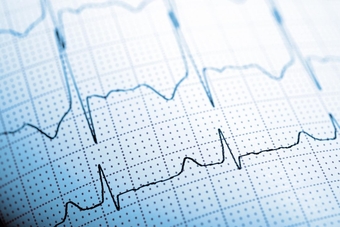
LA JOLLA, CA-Clinicians often use a medical test called a 12-lead electrocardiogram (ECG) to diagnose heart problems, which uses electrodes placed on the chest and limbs to record the heart's electrical activity. Artificial intelligence (AI) tools are commonly used to assist with diagnoses based on ECGs. But current tools typically require large amounts of training data, hand-labeled with the presence or absence of specific diseases, which can make the tools not very adaptable to other clinical tasks.
Now, scientists at Scripps Research have built a new AI model to improve detection and prediction of various heart diseases, which may be particularly useful in settings with limited labeled data or fewer available ECG leads. Published in Lancet Digital Health on September 1, 2026, the new tool, called ECG-CLIP, was trained using over 1.7 million ECGs collected from more than 540,000 people and paired with clinicians' notes, embedding the tool with knowledge that may make it more adaptable for different disease detection and prediction tasks in real-world clinical environments.
Our new algorithm only needs to see on the order of a dozen confirmed ECGs of a specific disease to detect that disease in the future, says senior author Giorgio Quer, an assistant professor of digital medicine at Scripps Research. This is similar to how a clinician would learn: not from a million examples, but from understanding the general physiology behind an ECG first and then seeing a few specific cases.
ECG-CLIP is a foundation model, which is a type of AI model that learns from diverse datasets, after which it can be used to perform many different tasks. Once ECG-CLIP was fully trained, Quer's team set out to test how it performed three clinical tasks compared with existing models. These included two supervised baseline models (a standard deep learning model and a linear model), a general foundation model (not trained on ECGs), and three ECG-trained foundation models.
The first task the team tested was detecting heart diseases. They selected three types to look for: acute myocardial infarction, cardiac amyloidosis and hypertrophic cardiomyopathy. The researchers then gave each model a new dataset containing over 800,000 ECGs and asked which showed signs of the three diseases. Using an area under the curve (AUC) method-measuring how well a model distinguishes between ECGs from people with and without a particular condition-Quer's team found that ECG-CLIP consistently performed better than the standard models at detecting all three diseases.
The team also found that across the three disease-detection tasks, ECG-CLIP matched the performance of the next-best model trained on the full dataset while using about 91% less hand-labeled training data on average.
Compared with the three ECG foundation models-which were trained on ECGs, but not clinician notes-ECG-CLIP also performed better in settings where the amount of labeled training data was limited (as few as 10 positive examples of a given disease). The differences in performance between ECG-CLIP and the other models generally disappeared as the number of labeled examples increased.
We found that ECG-CLIP was better at detecting and predicting cardiovascular diseases, particularly in cases where there was much less data, says Quer. This may be particularly useful in cases like rare diseases, where there are only a dozen or so positive examples of well-labeled ECGs that can be used for training the model.
ECG-CLIP also performed well using single-lead ECG data in tests of acute myocardial infarction detection, which may make it helpful in settings where resources are limited.
The second task tested was predicting heart disease. Here, members of Quer's lab focused on the models' ability to predict atrial fibrillation-a type of irregular heart rhythm. They found that ECG-CLIP outperformed all other models at predicting future atrial fibrillation from 12-lead ECGs displaying normal heart rhythms.
The final task was predicting adverse health outcomes. ECG-CLIP demonstrated the best performance of the tested models at predicting the likelihood of survival in 30 days following an emergency department visit or surgery, and the likelihood of chronic disease development-specifically chronic kidney disease and type II diabetes-within three years.
A common problem with AI tools is that it can be unclear what specific features of the data the model uses to make decisions. To help visualize this, the researchers generated saliency maps. These maps highlight regions within the signal that are contributing most to the model's predictions, which gives clinicians a clearer view into ECG regions that the model relied on. Quer's team implemented saliency maps to help make ECG-CLIP's output more interpretable, which can help build trust with clinicians and increase the likelihood of deployment in the clinic.
Going forward, Quer's team aims to expand the type of data available to the model to improve its performance in specific settings, like the emergency department. The team also hopes to evaluate its compatibility with different types of ECG recording systems, like wearable devices-where integration could eventually allow continuous, remote heart disease monitoring.
While these findings demonstrate substantial potential, rigorous validation in prospective clinical trials will be required to establish ECG-CLIP's applicability in real-world clinical settings, says the study's co-first author Michael Ko, a graduate student and research assistant at Scripps Research.
The work adds to an expanding collection of AI algorithms developed by Quer's lab to screen for and diagnose heart conditions. This includes an algorithm developed in 2024 to diagnose heart attacks and rhythm disturbances just as accurately when o
More from Scripps
17/09/2026
LA JOLLA, CA-While the brain orchestrates metabolic processes in the body, it al...
11/09/2026
LA JOLLA, CA-Transthyretin amyloid disease (ATTR) is a progressive, life-threatening condition caused when the protein transthyretin (TTR) breaks apart and aggr...
05/09/2026
LA JOLLA, CA-In recognition of his exceptional work to understand the chemistry of carbohydrates and the role they play in health and disease, Scripps Family Ch...
02/09/2026
LA JOLLA, CA-Influenza viruses constantly shapeshift to evade recognition by the immune system. This shapeshifting occurs in critical proteins like hemagglutini...
02/09/2026
LA JOLLA, CA-Clinicians often use a medical test called a 12-lead electrocardiogram (ECG) to diagnose heart problems, which uses electrodes placed on the chest ...
02/09/2026
LA JOLLA, CA-Proteins may look like rigid molecular structures, but inside our c...
28/08/2026
LA JOLLA, CA-Scripps Research has established the Pete Schultz Fund for Innovati...
28/08/2026
LA JOLLA, CA-Chemical structures called cyclopropanols are among the most useful...
26/08/2026
LA JOLLA, CA-Recent advances in robotics, automation and artificial intelligence...
26/08/2026
LA JOLLA, CA-Jeffery Kelly, the H. Lutcher Brown Professor of Chemistry at Scrip...
20/08/2026
LA JOLLA, CA-Scripps Research assistant professor Tiantian Liu has received a five-year NIAID DP2 award from the National Institute of Allergy and Infectious Di...
18/08/2026
The relationships built during graduate school often continue to shape careers long after a degree is earned, creating a community of scientists who learn from ...
13/08/2026
Scripps Research has established the Peter K. Vogt Endowed Chair, a new faculty ...
13/08/2026
LA JOLLA, CA-A vaccine's molecular structure plays a key role in determining how the immune system responds and prepares to protect the body from future exp...
12/08/2026
LA JOLLA, CA-Scientists at Scripps Research have discovered that two seemingly unrelated cellular enzymes become locked together during times of stress, simulta...
06/08/2026
LA JOLLA, CA-Scripps Research has received more than $500,000 in first-year fund...
06/08/2026
LA JOLLA, CA-Viruses are masters at invading our cells thanks to specialized proteins that coat their surfaces. When scientists design vaccines, they often crea...
06/08/2026
LA JOLLA, CA-The brain has its own immune system, which detects threats and mounts a defense. A growing body of evidence has shown that in Alzheimer's disea...
06/08/2026
LA JOLLA, CA-Scripps Research chemist Jin-Quan Yu has been elected to the National Academy of Sciences (NAS), one of the highest honors a scientist can achieve....
06/08/2026
LA JOLLA, CA-Scripps Research ranked third in the inaugural 2026 Cure Innovation Index recognizing the top-performing institutes and centers across the United S...
06/08/2026
Benjamin Cravatt, the Gilula Chair of Chemical Biology and a professor of chemis...
06/08/2026
LA JOLLA, CA-Dennis Burton, professor and the James & Jessie Minor Chair in Immu...
06/08/2026
LA JOLLA, CA-Inside every human cell, proteins are constantly being tagged with small chemical modifications after they're produced. Known as post-translati...
06/08/2026
LA JOLLA-Scripps Research has established the Ian Wilson Endowed Chair, a new fa...
06/08/2026
Scripps Research's Skaggs Graduate School of Chemical and Biological Science...
06/08/2026
LA JOLLA, CA-Professor Jin-Quan Yu of Scripps Research has been elected to the Fellowship of the Royal Society, the U.K.'s national academy of sciences and ...
06/08/2026
LA JOLLA, CA-For years, researchers have been hoping for vaccines that protect people against not just one strain of HIV, but every strain of the quickly mutati...
06/08/2026
LA JOLLA, CA-The Calibr-Skaggs Institute for Innovative Medicines, the nonprofit...
06/08/2026
LA JOLLA, CA-Building the complex 3D molecules needed for new medicines has alwa...
06/08/2026
LA JOLLA, CA-Fentanyl and related variants of the synthetic opioid kill more Americans each year than car accidents and gun violence combined. In too-high doses...
06/08/2026
LA JOLLA, CA-What do decoding communication between organs and reimagining the future of genome editing have in common? They're among the scientific questio...
06/08/2026
LA JOLLA, CA-Of the 1.2 million people living with HIV in the United States, app...
06/08/2026
LA JOLLA, CA-For some people, cancer immunotherapies are life-changing. These treatments can turn the body's own immune system against a tumor, either elimi...
06/08/2026
LA JOLLA, CA-Many conditions that cause vision loss share a common feature: the ...
06/08/2026
LA JOLLA, CA-RNA interference is a natural mechanism for living cells to control whether specific genes are being used or not.
Crowned with the 2006 Nobel Priz...
06/08/2026
LA JOLLA, CA-The drugs that keep rheumatoid arthritis in check may one day help people stop drinking. A new Scripps Research study shows that an anti-inflammato...
06/08/2026
LA JOLLA, CA-Antibiotic resistance is one of the most urgent threats to global health, linked to an estimated 4.7 million deaths worldwide in 2019 alone. As mor...
06/08/2026
LA JOLLA, CA-Some of the world's best-selling diabetes drugs depend on a che...
06/08/2026
LA JOLLA, CA-Detecting infectious disease threats early and responding quickly can dramatically alter the course of an infectious outbreak. Technologies such as...
06/08/2026
LA JOLLA, CA-Molecular biophysicist Joan Pulupa will join Scripps Research in Ja...
06/08/2026
LA JOLLA, CA-HIV is globally so diverse, consisting of hundreds of thousands of ...
07/07/2026
Scripps Research scientists train the immune system to make antibodies against numerous HIV strains Preclinical findings mark progress toward a long-sought vacc...
03/07/2026
Scripps Research scientists awarded $2M to advance global disease surveillance Two Gates Foundation grants will expand wastewater surveillance and AI-driven dis...
03/07/2026
Joan Pulupa joins Scripps Research faculty to study the organization of DNA in brain cells and its links to neurodegeneration Using smell-sensing neurons and ad...
30/06/2026
Scripps Research scientists demonstrate a faster, cheaper route to making critical drugs using common table sugar New method illustrates how to build a tough ch...
25/06/2026
Immune molecule may drive excessive drinking in alcohol use disorder Scripps Research scientists showed that blocking an immune molecule tied to inflammation r...
23/06/2026
Newly identified molecule strengthens the eye's response to damage in retinal disease Scripps Research discovery finds that restoring the naturally occurrin...
19/06/2026
Lab studies explain how new cancer drug works as it enters patient testing Immunologists at Scripps Research show how a new, experimental drug revives immune ce...
17/06/2026
Calibr-Skaggs awarded $5.1M by NIH to develop long-acting hepatitis B virus therapy A new program aims to replace a daily HBV drug with once-monthly or even qua...
12/06/2026
A fentanyl countermeasure that adapts to combat future black-market drugs Scripps Research scientists developed a vaccine that teaches the immune system to rapi...














 LA JOLLA, CA-Clinicians often use a medical test called a 12-lead electrocardiogram (ECG) to diagnose heart problems, which uses electrodes placed on the chest and limbs to record the heart's electrical activity. Artificial intelligence (AI) tools are commonly used to assist with diagnoses based on ECGs. But current tools typically require large amounts of training data, hand-labeled with the presence or absence of specific diseases, which can make the tools not very adaptable to other clinical tasks.