NFL Playoffs 2026: ESPN's Run Brings Monday Night Football' Flagship Operation Into JanuaryThe few changes reflect an emphasis on crowd energy, sideline emotionBy Brandon Costa, Director of Digital
Friday, January 9, 2026 - 3:13 pm
Print This Story | Subscribe
Story Highlights
January may mean brighter lights for the NFL, but, for ESPN's operations group, this time of year is about execution, not experimentation. When the broadcaster caps Wild Card Weekend with an AFC matchup between the Houston Texans and the Pittsburgh Steelers on Monday night, the behind-the-scenes story is less about what changes and more about how a season-long production model scales into the postseason.
Playoffs are always a different animal, says Tommy Mitchell, senior manager, remote operations, ESPN. The games are bigger. There's more at stake as every game is win or go home.' At the end of a long grind of a season, it's always exciting for the operations team to get recharged with the atmosphere.
CLICK HERE for all SVG's NFL Playoffs 2026 coverage
The Wild Card game in Pittsburgh, along with next week's Divisional Round matchup, represents the postseason extension of a Monday Night Football operation that has spent the fall refining a new technical foundation, from a brand-new IP mobile unit to evolved camera and replay workflows.
The continuity is intentional. ESPN's playoff coverage is designed to scale, not reset, allowing the Monday Night Football infrastructure - people, trucks, connectivity, workflows - to move seamlessly from Week 1 into January.
Nearly 60 Cameras, With Atmosphere in MindFrom a pure production standpoint, the Wild Card game is anything but scaled back. It marks the broadcaster's fifth straight year closing out the opening round of the NFL Playoffs, and its camera complement for Texans-Steelers is just shy of 60 cameras, including 28 with super-slow-motion (SSMO) capabilities.
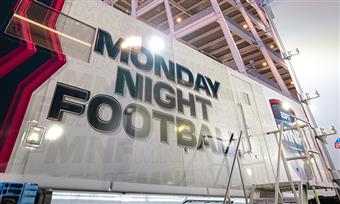
ESPN will broadcast Monday night's AFC Wild Card game between the Texans and Steelers in Pittsburgh. The main game broadcast will be run from inside ESPN's new top-flight mobile production unit Game Creek Video Flagship. (Photo: ESPN)
We will have two Steadicam Ronin shallow-depth-of-field rigs, a SkyCam, a Winged Vision aerial, and a drone, Mitchell says. Our normal complement of down-the-line robos, goal-line robos, and both end-zone and line-to-gain pylon cameras will also be in the mix.
The playoff environment has prompted some targeted additions. We are adding a few key features, he notes, including a 4K SSMO hard camera as well as an additional RF handheld to capture more of the playoff atmosphere. The additions will continue to enhance our coverage of the playoff atmosphere in Pittsburgh.
The additions aren't about technology for technology's sake. They reflect ESPN's desire to lean harder into crowd energy, sideline emotion, and the subtle visual cues that distinguish a January playoff game from a November division matchup.
A New Voice at the Front BenchThe visual evolution this season hasn't been limited to new lenses. It has also been shaped by a new set of eyes calling the show.
The 2025 season was the first directing Monday Night Football for longtime FOX NFL director Artie Kempner, who joined producer Steve Ackels at the front bench. Kempner's arrival brought a fresh perspective to one of the most established production units in sports television, influencing everything from camera deployment to how ESPN thinks about evolving a decades-old franchise.
Although the playoff operation mirrors the regular season structurally, it now carries the fingerprints of a director who spent more than three decades shaping FOX Sports' NFL coverage. Throughout the fall, Kempner worked closely with ESPN's remote-operations group to refine workflows, explore new camera applications, and challenge longstanding assumptions about how MNF should look and feel.
From subtle adjustments in RF and specialty-camera use to how replay resources are layered into the show, the postseason marks the continuation of that first-year collaboration - one that began with the launch of a mobile unit in September and now extends into the highest-pressure environment of the NFL calendar.
Flagship and Discovery Anchor the CompoundThe production footprint in Pittsburgh closely mirrors what ESPN has deployed all season. In the postseason, that regular-season foundation simply expands. Game Creek Video Flagship houses the game broadcast, while Game Creek Discovery supports studio operations, including NFL Live, Monday Night Countdown, and onsite editions of SportsCenter.
ESPN's NFL studio team will be onsite with the regularly scheduled NFL Live and Postseason NFL Countdown. (Photo: Allen Kee/ESPN Images)
On the studio side, ESPN's presence extends well beyond pregame hits. Yes, our studio is onsite with our regularly scheduled 3 p.m. NFL Live as well as Postseason NFL Countdown, says Mark Mignini, senior manager, remote operations, ESPN. Our stage will be on the sidelines for those shows. Technically speaking, no changes in making TV: eight cameras in total - four on the set, roaming Steadicam and a Ronin rig on the field for b-roll, demos, and potential pregame interviews; locker-room and possible tailgate footage.
He adds that SportsCenter will also originate from Acrisure Stadium, with split onsite shows planned for both 2 p.m. and 5 p.m. editions, extending ESPN's physical footprint across nearly the entire game day.
The separation between game and studio units continues to be a key structural advantage, allowing each team to operate independently while sharing resources and infrastructure across the compound.
A Matured Workflow, Not a Reinvented OneFrom a workflow standpoint, ESPN's playoff operation looks int
More from Sports Video Group
03/03/2026
Beyond Sports, a Sony group company, and LIV Golf, the world's golf league, ...
03/03/2026
Ilitch Sports + Entertainment announces the launch of Detroit SportsNet (DSN), a year-round broadcast home for two of Detroit's franchises. With flexible op...
03/03/2026
Advanced Systems Group, LLC (ASG), a technology and services provider for media ...
03/03/2026
The PGA of America, NBC Sports and USA Sports extend their media rights agreemen...
03/03/2026
AI device ecosystem company HONOR enters into a strategic technical collaboratio...
03/03/2026
Cleveland's Telos Alliance, pioneers in broadcast technology for 30 years, l...
03/03/2026
The MD 9235 microphone head for wireless handhelds has been a firm favorite with many engineers and artists for its ability to cut through high on-stage levels ...
03/03/2026
Haivision Systems Inc. (Haivision), a global provider of mission-critical, real-...
03/03/2026
Broadcast Management Group (BMG) announces the expansion of its 62,000-square-fo...
03/03/2026
Maroon 5's musical tour in 2025 marked a leap forward in live audio as Monitor Engineer Dave Rupsch utilized Sennheiser's all-digital Spectera wireless ...
03/03/2026
Designed specifically for pro basketball, the renovated space at Gainbridge Fiel...
03/03/2026
As part of the move, former CEO Phillipp Lawo joins the broadcast-tech provider's Supervisory Board
Lawo has announced appointment of Jamie Dunn as chief e...
03/03/2026
A team of legendary announcers and analysts and a classic graphics look will bring the past to life
NBC Sports and Peacock will return to yesteryear for tonigh...
02/03/2026
NBC Sports selected Imaginary Forces to create the main title sequence for the M...
02/03/2026
The NFL announces the launch of the NFL Draft Innovation Challenge, a new crowds...
02/03/2026
The World Teleport Association (WTA) has named Skyline Communications' DataMiner SatOps solution as a finalist for the 2026 Teleport Technology of the Year ...
02/03/2026
Ventum Tech announces a strategic partnership with Pixotope, a real-time graphic...
02/03/2026
Victory , a free, ad-supported sports streaming service, announces the launch of...
28/02/2026
With two features seen in Formula 1 coverage, the broadcaster aims to bring view...
27/02/2026
The E.W. Scripps Company names Oliver Gray as Vice President, Network Sports and...
27/02/2026
The Gotham Sports App, the exclusive direct-to-consumer streaming home of MSG Networks and the YES Network, is now available for purchase through Prime Video fo...
27/02/2026
ESPN and the Horizon League announce a new multi-year, multi-platform media rights agreement, continuing a 38-year collaboration that began with the 1988 Midwes...
27/02/2026
At the 2026 NAB Show in Las Vegas, NETGEAR will highlight its new switch models and major updates to its Engage Controller software. The company's network d...
27/02/2026
Riedel Communications announces that Fondazione Teatro alla Scala has deployed a...
27/02/2026
Lyuno specializes in media localization, including translation, dubbing, subtitling, and voice-over services for a wide array of entertainment content. The comp...
27/02/2026
Chyron Weather 2.3, the latest edition of Chyron's weather visualization suite for broadcasters and meteorologists, recently launched.
The release includes...
27/02/2026
Telestream, which concentrates in media workflow technologies, announces expanded practical AI enhancements across its Vantage, Vantage Cloud, EDC, Stanza, and ...
27/02/2026
Horizon Sports & Experiences (HS&E), a global sports marketing, media, and live ...
27/02/2026
Legendary sports broadcasters Bob Costas, Doug Collins, Mike Czar of the Telest...
27/02/2026
Beginning on March 1st, IndyCar will be kicking off their 31st season on the str...
27/02/2026
In-venue and creative video staffers at the professional and collegiate level ha...
27/02/2026
Ratings Roundup is a rundown of recent rating news and is derived from press rel...
27/02/2026
Owl AI a pioneer in artificial intelligence for professional sports, announces a...
27/02/2026
With over 447 million fans in APAC, Formula 1 and beIN will continue to innovate...
27/02/2026
12-year-old Noelle Taylor will be the Kid Reporter when the Brooklyn Nets host t...
27/02/2026
Entire CapCam system - including camera unit, RF transmitter, and battery - is h...
26/02/2026
Multi-angle coverage, on-demand access to ultra-high-resolution video are provided for replays and clips across multiple distribution channels
The NHL and Cosm...
26/02/2026
Advanced Systems Group, LLC (ASG), a technology and services provider for media creatives and content owners, has appointed Jody Boatwright as Chief Strategy Of...
26/02/2026
As players report to Spring Training, TikTok and MLB announce an expanded content partnership bringing baseball fans around the world closer to the game through...
26/02/2026
Chyron announces its 2026 Designer of the Year Competition to be awarded during a live stream from the 2026 NAB Show in Las Vegas. This year's competition i...
26/02/2026
Appear, which specializes in live production technology, announces that its X Platform has been officially verified by YouTube for Secure Reliable Transport (SR...
26/02/2026
Adder Technology, a specialist in connectivity solutions and high performance IP...
26/02/2026
Harmonic announces that Alcom, a leading telco operator in Finland, is powering its next-generation white-label headend video service with Harmonic's XOS Ad...
26/02/2026
ESPN, Disney , and the Savannah Bananas announce a 25-game exclusive package in ...
26/02/2026
Brazilian broadcaster Globo has returned as the official broadcast partner of th...
26/02/2026
NDI, which concentrates in plug-and-play IP video connectivity, announces a strategic partnership with Jiaruisen (JRS), a Shenzhen-based technology distributor,...
26/02/2026
The Charleston, SC, native has excelled as a live-camera operator on Tigers broadcasts
In the live-sports-video industry, the future is bright. Our series SVG ...
26/02/2026
Behind The Mic provides a roundup of recent news regarding on-air talent, including new deals, departures, and assignments compiled from press releases and repo...
26/02/2026
Supported by partners, the in-venue production team keeps videoboard-show qualit...
26/02/2026
CAMB.AI provides AI speech synthesis and translation with a focus on localizatio...














 NFL Playoffs 2026: ESPN's Run Brings Monday Night Football' Flagship Operation Into JanuaryThe few changes reflect an emphasis on crowd energy, sideline emotionBy Brandon Costa, Director of Digital


