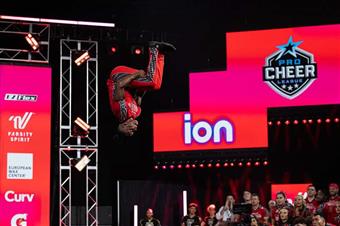
UpLight Technologies delivers a flexible video and lighting system for a new televised sportLaunching the Pro Cheer League required more than creating a compelling in-venue experience-it demanded a production system capable of supporting a live national broadcast from day one.
Developed by Varsity Spirit and aired on ION Television, the league represents the first professional cheerleading format designed specifically for both arena audiences and television viewers. For UpLight Technologies, the challenge was to design and deploy a system where video, lighting, and control infrastructure could integrate seamlessly with the broadcast workflow.
We had to build something that works for television first, says David Surbrook, Owner of UpLight Technologies and Production Designer for the tour. At the same time, it still had to feel like a major arena show for the audience in the room.
Photo credit: Pro Cheer League
From the outset, the production was structured to align with the needs of a live sports broadcast. The touring format-spanning arenas and convention centers-introduced variability in rigging, space, and infrastructure, but the requirement for consistent on-camera results remained constant.
We knew the show would be shot in different environments, Surbrook explains. So the system had to be flexible while delivering the same visual identity regardless of the venue.
At the heart of the production was a modular LED system built around a broadcast-friendly philosophy: maintain a clean, standard-format canvas while allowing flexibility around it. The main display provided a true 16:9 surface for game graphics, sponsor integration, and broadcast elements. Surrounding this were staggered side wings and floor-mounted pods.
We required a large center wall configuration to accommodate the 16:9 feed from the truck and provide dedicated space for sponsor displays, says Video Designer and Systems Integrator James Mitchell. The staggered side walls maximize the set's width while adding visual interest.
Equally important for broadcast was the panel finish.
The matte surface was a big factor, Surbrook adds. It absorbs light, which prevents reflections and keeps the image clean for the camera-especially with athletes performing above the screen.
Photo credit: UpLight Technologies
A broadcast-first approach extended into the system architecture. The LED system was driven by dual Brompton SX40 processors, paired with four XD breakout boxes for distributed data management. All video signals passed through an Analog Way Zenith 200 switcher, which served as the central routing hub.
We built redundancy into every stage, Mitchell explains. Inputs hit the switcher, then feed both processors simultaneously. From there, we distribute over multiple 10G lines, with active backups across the entire path.
Eight Cat6a trunk lines connected the processors to the XD units, with two handling primary data distribution and two configured as looped backups. Playback was handled via a MacBook Pro running Resolume Arena with the Stageflow plugin, paired with a Blackmagic DeckLink 8K Pro G2 card for output.
We tested several playback solutions during prep, Mitchell notes. Resolume with Stageflow gave us the flexibility to manage content quickly while maintaining stability.
The system also enabled seamless server switching via the Zenith 200, ensuring uninterrupted output in the event of a failure.
Maintaining synchronization between LED content, cameras, and lighting was critical for broadcast. Frame rates were matched across the entire production ecosystem to avoid scanline artifacts, while overall latency remained low enough to support IMAG and live graphics without noticeable delay.
Everything needed to feel immediate, Mitchell says. Whether it was graphics, replays, or live camera feeds, there couldn't be any disconnect.
Content for the show came from multiple sources, including the television production team and Varsity Spirit. The center LED wall was partially controlled by the broadcast truck for game graphics and scoring, while UpLight managed the surrounding displays and environmental content.
Resolume with Stageflow allowed us to build looks quickly and manage focal points, Mitchell explains. That was important in a live format where things are constantly evolving.
The system allowed for real-time adjustments during rehearsals and live competition, ensuring that branding, team identity, and broadcast elements remained aligned.
Lighting design was equally influenced by broadcast requirements. Unlike concert environments, where dramatic contrast can drive the visual experience, this production required consistent illumination of the performance area to support camera coverage.
You always have to assume the camera is live, Surbrook says. You can't lose the athletes.
For that purpose, the rig employed high-CRI wash fixtures for even coverage on the mat and clear visual depth for cameras. In addition, beam and pixel-mapped fixtures were used to create motion and energy.
I wanted something animated-something that adds excitement and sparkle-without pulling focus from the athletes, says Surbrook. It's about blending a theatrical sensibility with the energy of a live concert, while still holding up for broadcast.
Integration between lighting and LED was also a key design feature, with fixtures positioned beneath the LED wings to create a unified visual field on screen.
Photo credit: Pro Cheer League
Despite the complexity of the system, the production ran without major technical issues throughout the tour.
No signal problems, no major reconfigurations on-site, Mitchell says. That comes down to preparation and building the system with redundancy from the start.
While content evolved during rehearsals, the underlying infrastructure remain
North America Stories
25/06/2026
Share
Copy link
Facebook
X
Linkedin
Bluesky
Email...
25/06/2026
Share
Copy link
Facebook
X
Linkedin
Bluesky
Email...
25/06/2026
Share
Copy link
Facebook
X
Linkedin
Bluesky
Email...
25/06/2026
Immune molecule may drive excessive drinking in alcohol use disorder Scripps Research scientists showed that blocking an immune molecule tied to inflammation r...
24/06/2026
Streaming sets record high of 46.6% of ad supported TV viewing, driven by Super Bowl and Winter Olympics; overall share of ad supported TV remains steady
NEW Y...
24/06/2026
Share
Copy link
Facebook
X
Linkedin
Bluesky
Email...
24/06/2026
Share
Copy link
Facebook
X
Linkedin
Bluesky
Email...
24/06/2026
Share
Copy link
Facebook
X
Linkedin
Bluesky
Email...
24/06/2026
RE:Vision Effects Announces Twixtor Standalone v 8.1 and a Sale!
Brie Clayton June 24, 2026
0 Comments
Twixtor v8.1 Standalone adds support for variab...
24/06/2026
Dreamtek Uses Full Blackmagic Workflow for Vercel Next JS Event
Brie Clayton June 24, 2026
0 Comments
Blackmagic cameras, switchers, routers, recorder...
24/06/2026
Chyron LIVE Unveils New Features: Haivision StreamHub Integration, SCTE-35 Ad In...
24/06/2026
Mapping an Education How composer Chloe Clarke Smith navigated her Boston Conservatory experience and brought new meaning to her work
June 24, 2026
By
Sara...
24/06/2026
The Next Act Dean Krisha Marcano's vision for a connected Theater Division, and the fund making it possible
June 24, 2026
Photo by Eric Antoniou
The Or...
24/06/2026
Announcing STAGES Magazine 2026 Marking a decade since Boston Conservatory and Berklee College of Music joined forces, this issue spotlights some of the groun...
24/06/2026
In Brazil's TV 3.0 Trials, Appear's X5 is transporting live signals from Bras lia to S o Paulo over the public internet using secure, reliable next-gene...
24/06/2026
Melbourne, Australia - 24 June 2026: Mediaproxy, the global standard for software-based IP compliance monitoring and multiviewing solutions, has named Heartland...
24/06/2026
Share
Copy link
Facebook
X
Linkedin
Bluesky
Email...
24/06/2026
Share
Copy link
Facebook
X
Linkedin
Bluesky
Email...
24/06/2026
Share
Copy link
Facebook
X
Linkedin
Bluesky
Email...
24/06/2026
First Rush Brings SDI Multicam ProRes Recording to Apple Silicon Macs
Brie Clayton June 23, 2026
0 Comments
First Rush is a native macOS application d...
24/06/2026
Vertical Drama Beneath Crimson Sails Created with Blackmagic Design
Brie Clayton June 23, 2026
0 Comments
Thunder Child Productions relies on cameras&...
24/06/2026
Why Dynamic Media Facilities Matter In this series, we explore the technologies, architectures and operational realities shaping modern media operations. Along ...
23/06/2026
When we began planning our transition from an SDI-based infrastructure to a new ...
23/06/2026
Imagine Communications has announced the appointment of Greg Garmon as Senior Vice President, Americas Video Sales. Garmon will oversee account growth and busin...
23/06/2026
Snap has promoted Emma Wakely to Head of Sports and Media Partnerships, Americas, succeeding Anmol Malhotra, who has been elevated to Global Head of Content and...
23/06/2026
YES Network and The Gotham Sports App will air MI New York's Major League Cr...
23/06/2026
The Universal Talent Identifier (HAND) has issued HAND IDs to 34 top projected prospects in the 2026 NBA Draft class, including AJ Dybantsa, Cameron Boozer, and...
23/06/2026
World Boxing has announced the launch of World Boxing TV, a subscription-based streaming platform built on the Joymo platform, offering live events, on-demand c...
23/06/2026
FloSports will stream 32 off-road motorcycle racing events on FloRacing, includi...
23/06/2026
SES has announced the expansion of its ASTRA TV platform in Spain with the addition of 14 regional channels in HD and UHD quality and the launch of new hybrid s...
23/06/2026
Appear ASA has announced its role in Rede Legislativa de R dio e TV's contri...
23/06/2026
LTN has announced that PBS has selected it as its IP video partner to modernize content distribution and contribution across more than 330 public television sta...
23/06/2026
Ease Live has announced that its graphics overlay platform is powering an interactive fan experience on Rally.TV, the official streaming platform of the FIA Wor...
23/06/2026
Chyron has announced updates to Chyron LIVE, its cloud-native live production pl...
23/06/2026
ESPN has announced ESPN Fan House, a fan engagement hub powered by Flowcode, launching in August ahead of the 2026 college football season. Publicis Sports will...
23/06/2026
The city's solid position in broadcast, entertainment, and sports attracted the major microphone manufacturer
Sennheiser Group is moving its Americas Regio...
23/06/2026
Share
Copy link
Facebook
X
Linkedin
Bluesky
Email...
23/06/2026
PlayBox Neo appoints Besco as Channel Reseller to establish a firm foothold in Asia Pacific's thriving high-tech export-driven economic boom
PlayBox Neo, t...
23/06/2026
Share
Copy link
Facebook
X
Linkedin
Bluesky
Email...
23/06/2026
LTN, a global leader in IP-based video transport and network services, today announced that PBS has selected LTN as its IP video partner to modernize and future...
23/06/2026
LiveU will introduce its Q Era to Australia and New Zealand for the first time at ABE2026 on Stand No. 25, (July 30 31). Leading the showcase is the LU900Q, a n...
23/06/2026
Miri Technologies Inc. has begun shipping its highly anticipated V410 live 4K video encoder/decoder for streaming, IP-based production workflows and AV-over-IP ...
23/06/2026
DHD audio reports the completion of an upgrade to the audio production facilities at the Galilee headquarters of Radio Tzafon. The station broadcasts two progra...
23/06/2026
Share
Copy link
Facebook
X
Linkedin
Bluesky
Email...
23/06/2026
Share
Copy link
Facebook
X
Linkedin
Bluesky
Email...
23/06/2026
Share
Copy link
Facebook
X
Linkedin
Bluesky
Email...
23/06/2026
Share
Copy link
Facebook
X
Linkedin
Bluesky
Email...
23/06/2026
Share
Copy link
Facebook
X
Linkedin
Bluesky
Email...
23/06/2026
Multifaceted Growth Executive Brings 20+ Years of Experience Leading Organizations Across Tech and M&E
Imagine Communications today announced the appointment ...
23/06/2026
Visual Productions Unveils RdmRelay2 Four-channel Relay Control at InfoComm 2026
Brie Clayton June 22, 2026
0 Comments
New Relay Solution Combines DMX, ...














 UpLight Technologies delivers a flexible video and lighting system for a new televised sportLaunching the Pro Cheer League required more than creating a compelling in-venue experience-it demanded a production system capable of supporting a live national broadcast from day one.


