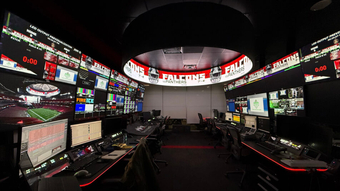
New LED provides enhanced quality control, quicker show prep, detailed production execution
AMB Sports and Entertainment (AMBSE), and specifically the individuals associated with Mercedes-Benz Stadium in downtown Atlanta, are always ideating and conceiving of ways to accelerate their workflows and escalate their production quality for fans of the NFL's Atlanta Falcons, MLS's Atlanta United, and more. Debuting during a back-to-back of a Falcons preseason game vs. the Denver Broncos on Aug. 14 and Atlanta United vs. New York Red Bulls on Aug. 15, a miniature version of the Halo Board centerhung installed inside of the control room is providing a massive assist for gameday shows at the venue.
The Mini Halo Board is not just a technology upgrade - it really is a strategical tool that increases our ability to prepare for all of our events, cross-collaborate amongst each other in between different departments, reduces risk, and maintains a high production standard for our fans, our customers, and clients, says Julia Chongarlides, senior director & executive producer, stadium productions, Mercedes-Benz Stadium. Working closely with our engineering team, IT, and our vendors, we're able to make sure that everything's consistent, high-quality, and flexible.
A Control-Room Need: Recent Revamp, Tough Sightlines Encourage Installation
To complete a project like the Mini Halo Board, other elements needed to be put into place before this concept could be put into motion. Most importantly, the team had to implement a three-phased control room renovation in 2024 that included an upgrade to SMPTE 2110 and the inclusion of three independent tech stacks. After the revamp was complete and the entirety of the 2025 events calendar was under their belt, the organization felt the need to further refine their workflows for a more seamless game and event presentation. Through the leadership of AMBSE's COO Tameka Rish and the executive leadership team, additional funding was approved for the Mini Halo Board idea. We all met on a monthly basis and talked about the project, and at first, it just started out with asking what we want to get out of this, says Kevin Pope, VP and CIO, Mercedes-Benz Stadium. We realized that we really wanted to build a lot more redundancy into the project and better utilize our three individual tech stacks.
Furthermore, the impressive size of the Halo Board makes it really hard to see every nook and cranny of the video display from inside the control room. Striving for a more accurate and detail-oriented show, quality control is a must before showing content to a crowd of more than 70,000 fans on any given event.
One of the major challenges for the crew is previewing content before it goes to the board and making sure that it's correct, says Jeff Volk, EVP, strategic accounts, sports & live events, Alpha, who served as the systems integrator for the project alongside Broadcast Design Team Lead Mike Marshall. The other is visualization during the content creation process. It's very trial and error if you're an XPression artist because you have to rely on POV cameras that are looking up at the Halo or have to walk to another location to see the field to take notes on how the content looks on the display.
An Authentic Replica: Daktronics' New Flexible LED Modules Duplicate Full-Sized Board
With the obstacles clearly outlined, AMBSE leveraged the support of Daktronics to create their desired vision. Despite being close to a decade old, the Halo Board is still near the top of the list of the largest LED video displays in sports. Shrinking that expansive size to a smaller version, as well as copying the double-sided nature of this circular structure, can be a tough task.
All these stadiums have immaculate control rooms, but this one's so unique that they went as far to try to at scale replicate their main display in their control room, says Luke Tingle, project executive, Daktronics. When you put something in there that's so intentional, they're going to learn ways they never knew that could help them be more efficient.
This style of project is relatively new in the sports-video-production industry, but luckily, Daktronics has experience with these types of screens from their work with the government and medical communities. This includes the use of the LED providers' flexible modules that offers durability, malleability, and the ability to display a tight 1.5 mm pixel pitch.
You can shake this flexible module like a thick piece of construction paper, and it still gives a smooth display appearance, adds Tingle. At that time of creating this product, we didn't know that this Mini Halo Board was coming out, so we're really excited to see it used.
From Mercedes-Benz Stadium's perspective, this outside-of-the-box thinking and willingness to implement this new product is what intrigued them the most.
They spent a lot of time [putting this together], says Cole Gallagher, chief broadcast & network A/V engineer, Mercedes-Benz Stadium. Usually, they're wrapping around a curve instead of a creating a complete circle, so when you move one module, everything downstream has to shift with it. That was one of the hardships that Daktronics faced, but they approached this as labor of love.
Finding the Time: Crew Completes Project Between End of 2026 FIFA World Cup, Start of NFL Season
Widely known as one of the busiest sports stadiums in the United States, the team at Mercedes-Benz Stadium rarely has enough down time to regroup, re-assess, and recalibrate for the next incoming event. If it's not the professional franchises that call Atlanta home, there's marquee college football games like the SEC Championship or the Chick-fil-A Peach Bowl and amateur sports like the coveted sport of high school footba
North America Stories
02/09/2026
Professional and collegiate clubs, leading vendors discuss current trends in stadium production
On. Aug. 12, the 2026 SVG Venues & Teams Summit explored the ev...
02/09/2026
SoFi Stadium, YouTube Theater, and Hollywood Park have completed an infrastructure upgrade expanding game presentation and broadcast production capabilities acr...
02/09/2026
Comcast Technology Solutions (CTS) has announced a suite of AI-powered workflow applications for broadcasters, content owners, and operators, built on its Video...
02/09/2026
The North American Broadcasters Association (NABA) and the Association of Professional Wireless Production Technologies (APWPT) have announced a partnership to ...
02/09/2026
Carolina Hurricanes, Anaheim Ducks, Columbus Blue Jackets, Dallas Stars, Minneso...
02/09/2026
New LED provides enhanced quality control, quicker show prep, detailed productio...
02/09/2026
Six-country survey finds 26% of sports fans frequently unable to determine where...
02/09/2026
Share
Copy link
Facebook
X
Linkedin
Bluesky
Email...
02/09/2026
Share
Copy link
Facebook
X
Linkedin
Bluesky
Email...
02/09/2026
Share
Copy link
Facebook
X
Linkedin
Bluesky
Email...
02/09/2026
Share
Copy link
Facebook
X
Linkedin
Bluesky
Email...
02/09/2026
KOKKEDAL, DENMARK, SEPTEMBER 1, 2026 DPA Microphones announces its new 6388 CORE Headset Microphone, a high-performance directional headset designed for dema...
02/09/2026
Pliant Technologies will highlight its CrewCom CXD 32CF 32x32 Dante /AES67 Digital Audio Network Interface, a powerful connectivity solution designed to expand ...
02/09/2026
iWedia, a leading provider of software solutions for connected TV devices, today announced two enhancements to Teatro Pulse, its end-to-end TV service operation...
02/09/2026
Signiant, trusted by the media industry for accelerated content movement for more than 20 years, will showcase the latest evolution of the Signiant Platform at ...
02/09/2026
With a contractual agreement to supply a leading UK sports broadcaster with outside broadcast services for 104 football matches per season over the next four ye...
02/09/2026
IBC2026 will put sport firmly at the centre of the global media and entertainment technology conversation with the strongest sports showing in the event's h...
02/09/2026
PTZOptics will bring a hands-on showcase of intelligent video production to IBC2026 (11-14 September, RAI Amsterdam), with demonstrations spanning new camera te...
02/09/2026
OOONA, a global provider of professional management and production tools for the media localization industry, today announced the launch of OOONA Go, a ready-to...
02/09/2026
EON Media will make its European debut at IBC2026 (September 11-14, RAI Amsterdam) in the show's Future Tech Zone (Hall 14.FT5). The company is launching it...
02/09/2026
Frequency, the engine behind many of the worlds leading streaming television channels, will demonstrate at IBC2026 how integrating intelligence throughout chann...
02/09/2026
On-device AI platform gives broadcasters and content creators purpose-built tools for real-time vertical video production and AI-enhanced sports coverage...
02/09/2026
Share
Copy link
Facebook
X
Linkedin
Bluesky
Email...
02/09/2026
Share
Copy link
Facebook
X
Linkedin
Bluesky
Email...
02/09/2026
Share
Copy link
Facebook
X
Linkedin
Bluesky
Email...
02/09/2026
Share
Copy link
Facebook
X
Linkedin
Bluesky
Email...
02/09/2026
Share
Copy link
Facebook
X
Linkedin
Bluesky
Email...
02/09/2026
Share
Copy link
Facebook
X
Linkedin
Bluesky
Email...
02/09/2026
Share
Copy link
Facebook
X
Linkedin
Bluesky
Email...
02/09/2026
Share
Copy link
Facebook
X
Linkedin
Bluesky
Email...
02/09/2026
Next-Generation Freeform Control Surfaces Lay the Foundation for AI-Enabled Media Operations
At IBC2026 (Sept. 11 14, RAI Amsterdam, Stand #1.B73), Imagine Com...
02/09/2026
Friedrichstadt-Palast in Berlin, the world's largest theater stage, has modernized its backstage production infrastructure with a comprehensive Riedel solut...
02/09/2026
Women in Media announces that it will host the two-day Reel/Forward in-person conference devoted to navigating today's production scene. Guests can enjoy pa...
02/09/2026
The expanded partnership brings Teradek's Live Production solutions to New Media AV's European dealer and integrator network, opening new opportunities ...
02/09/2026
QuickLink, a leading provider of award-winning video production and remote guest contribution solutions, announces a major expansion to its award winning Studio...
02/09/2026
BCNEXXT, the developers of the advanced playout platform Vipe, today announced that premium entertainment brand Foxtel has selected Vipe to underpin playout for...
02/09/2026
SubtitleNEXT helps HOT Telecom's subtitling team keep a cool head with reliable QC capabilities
Profuz Digital, global developer of digital media and local...
02/09/2026
Case Study: Mission Digital Strengthens Battery Safety with Safe-ion
As productions become increasingly dependent on battery-powered equipment, the safe storag...
02/09/2026
LA JOLLA, CA-Influenza viruses constantly shapeshift to evade recognition by the immune system. This shapeshifting occurs in critical proteins like hemagglutini...
02/09/2026
LA JOLLA, CA-Clinicians often use a medical test called a 12-lead electrocardiogram (ECG) to diagnose heart problems, which uses electrodes placed on the chest ...
02/09/2026
LA JOLLA, CA-Proteins may look like rigid molecular structures, but inside our c...
02/09/2026
J nger Audio flexAI Adds Autonomous Mixing, 12G-SDI, NDI, and TVU MediaMesh Int...
01/09/2026
Bridge Technologies will announce at IBC2026 (Booth 1.A71) that its VB440 produc...
01/09/2026
DAZN has announced an agreement to acquire EverPass Media, a commercial sports distribution platform serving bars, restaurants, hotels, and other venues in the ...
01/09/2026
The USTA and Kalshi have announced a multi-year partnership making Kalshi the Official Prediction Market Partner of the US Open, beginning with the 2026 US Open...
01/09/2026
MASV will exhibit at IBC2026 (Booth 5.B40, RAI Amsterdam, September 11-14). CTO Majed Alhajry will appear on a panel session, A Tale of Two Feeds: Automation o...
01/09/2026
FingerWorks Telestrators has announced a partnership with Broadcast Rental to ex...
01/09/2026
FOR-A has announced the expansion of viztrick AiDi into two dedicated products: Go Vertical! AiDi and AiDi Sports Hub. Developed by Nippon TV and delivered glob...
01/09/2026
Sony Pictures Television has launched Live TV on PS5, a free ad-supported streaming experience available to PS5 players in the United States. The service is acc...
01/09/2026
Friedrichstadt-Palast in Berlin has installed a Riedel production infrastructure spanning video, intercom, control, and I/O across the venue, implemented in col...














 New LED provides enhanced quality control, quicker show prep, detailed production execution