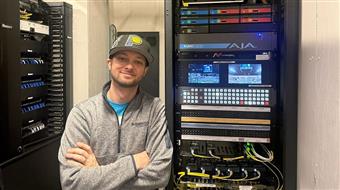
The production method, which spans a distance of 36.2 miles, was designed and implemented by the Pacers' in-house engineers
When the Noblesville Boom became an official franchise in spring 2025, the new G League Affiliate of the Indiana Pacers was in the midst of building a home at The Arena at Innovation Mile (AIM). After its subsequent opening last summer and with the help of an IP-based control room at the Pacers' Gainbridge Fieldhouse, Pacers Sports & Entertainment (PSE) has remotely produced the Boom's home broadcasts despite a 36.2-mile distance between Indianapolis and the town of Noblesville, IN.
When our G League team moved to Noblesville, we had to figure out what we wanted to do, says Emily Wright, AVP, broadcast engineering and operations, Pacers Sports & Entertainment. This model allows our production team to continue to use all the resources they know and are familiar with using for all our productions at Gainbridge Fieldhouse.
Finding the Answer: Engineers Determine the Best Course of Action
For an engineering team as forward-thinking as the PSE crew - which also includes Senior Broadcast Engineer David Hentz, Broadcast Engineer Cameron Smolinske, and IPTV Engineer Noah Jordan - this was a hefty but realistic problem to solve. At the end of the day, both the G League and the Boom required their games to be livestreamed on the league's website and on NBATV, ESPN+, and Tubi.
The Arena at Innovation Mile, which opened last summer, is the new home of the Noblesville Boom.Initial conversations about what could be done took place in January 2025; with a project of this size, any and every potential solution was discussed. Ideas ranged from building a permanent control room at AIM, using a mobile unit parked outside the venue as a traditional onsite model, or, the most tedious, setting up and striking a temporary production environment for every home game.
The third option was a possibility: it's what Smolinske did when the former Fort Wayne Mad Ants shifted their home games to the state's capital city. Ultimately, though, the strategy was scrapped.
We had leveled up our G League production when the team came down from Fort Wayne and played at Gainbridge for a few seasons, and we did not want to go back, Wright explains. Re-creating our control rooms in Noblesville was not a realistic option, and we considered just about everything else.
The venue is located 36.2 miles from the control room in the northwest Indianapolis suburb of Noblesville, IN.Understanding Smolinske's experience and how time-consuming this style of production would be, along with how costly building a control room at AIM or deploying a mobile unit would be, the team needed to find a way to replicate the production values generated at Gainbridge Fieldhouse without re-creating yet another setup. The answer was closer than expected: the remote-production route in the SMPTE ST 2110-powered control center. Featuring two control rooms, the facility, which opened in 2023, is more than capable and has become reliable during a calendar that has gotten busier by the year.
We wanted to have the same amount of horsepower to make those shows the best they can be, says Smolinske. It was a push from us because we have the capabilities and can do this now.
The remote-production setup, which officially went online in December 2025, is driven by a permanent tech stack of AJA Kumo's local-routing technology and MultiDyne gear connecting to Gainbridge Fieldhouse in Indianapolis.The result was a lightweight and low-footprint solution at AIM. The setup, installed during the venue's opening and launched in December 2025, features a permanent tech stack of AJA Kumo's local-routing technology and MultiDyne gear connecting AIM to Gainbridge Fieldhouse via the venue's rack room; in addition, two flypacks help send and receive 18 video feeds.
At Gainbridge Fieldhouse, two workflows in the rack room - EVS Cerebrum and similar gear from MultiDyne - allow any PSE engineer to natively tap into the remote network and stay connected to the Boom's home arena, respectively. This behind-the-scenes operation is creating a high-energy, fun-filled environment for Boom fans.
The fact that we can bring all of this to a production at AIM, which is 36.2 miles away, translates into a better guest experience for our fans all around, says Carl Ceresoli, chief information officer, PSE.
Closing the Gap: System Has Multiple Backup Plans, Near Zero-Second Latency
On the surface, the system seems straightforward, but, behind the curtain, Hentz is figuring out ways to ensure that contingency plans are in arm's reach and create ways to improve broadcast delivery. For the former, redundancies were baked into the initial design. Via intercoms installed in the control room at Gainbridge Fieldhouse, the crew can fix any issues remotely from Indianapolis or onsite in Noblesville to keep the broadcast on-air without interruption.
At Gainbridge Fieldhouse, MultiDyne hardware receives and sends 18 video feeds for the broadcasts. If we were to lose a fiber path, says Hentz, we're able to choose cameras from different sources and re-marry everything with a push of a single button. We also have four failover plans, including one that takes over the audio that gets used [for the in-venue production], uses the videoboard feed at AIM, embeds everything together, and sends the new feed to G League in no time.
For that plan, one of Hentz's main goals is to maintain the lowest latency possible. The 36.2-mile distance is quite long, and establishing connectivity to cover it can be expensive, but, with a preexisting fiber corridor in Noblesville, PSE needed to construct only a mile of fiber. Constructing all 36.2 miles would have cost $8.5 million. With a sturdy backbone in place, Hentz has c
North America Stories
01/05/2026
To celebrate the opening of its new showroom and office, Lightware UK hosted a dedicated launch event at the new London location. The event welcomed partners, c...
01/05/2026
Choice without compromise
The broadcast industrys transformation is accelerating, and traditional broadcasters are having to fundamentally reinvent how they o...
01/05/2026
Beam Dynamics will return to MPTS 2026 with its asset intelligence platform, helping systems integrators, live production teams, media facilities and profession...
01/05/2026
Best-in-class UX design and rapid, scalable delivery for next-generation viewing experiences
Leading video software provider, Synamedia, today announced a coll...
01/05/2026
Compact new cforce MAX lens motor brings unrivaled speed and responsiveness to t...
01/05/2026
Panavision welcomes Fritz Heinzle as Vice President of Sales
Brie Clayton May 1, 2026
0 Comments
Heinzle will support Panavision's global growth s...
01/05/2026
Share
Copy link
Facebook
X
Linkedin
Bluesky
Email...
01/05/2026
Share
Copy link
Facebook
X
Linkedin
Bluesky
Email...
01/05/2026
Share
Copy link
Facebook
X
Linkedin
Bluesky
Email...
01/05/2026
Share
Copy link
Facebook
X
Linkedin
Bluesky
Email...
01/05/2026
Share
Copy link
Facebook
X
Linkedin
Bluesky
Email...
01/05/2026
LONDON, APRIL 30, 2026 The Post Republic London's Re-recording Mixer and Dialogue Editor Dan Johnson has built a reputation for clean, emotionally resonan...
01/05/2026
Adobe Unveils Powerful New Innovations in Photoshop & Lightroom
Deepa Subramaniam April 30, 2026
0 Comments
Your most tedious creative tasks just got ea...
01/05/2026
Berklee Partners with Santander US to Establish Global Opportunity Fund The $400,000 grant offers students access to experiential learning opportunities withi...
01/05/2026
Student Spotlight: Keziah Thomas The Indian composer, who was named the 2026 student commencement speaker for Berklee College of Music, talks about how shes p...
30/04/2026
The Professional Women's Hockey League (PWHL) concluded its third regular season on Saturday, reporting growth across attendance, viewership, digital engage...
30/04/2026
NBC Sports will air national MLB coverage on Sundays beginning May 3, with MLB Sunday Leadoff on Peacock and NBCSN at 12:30 p.m. ET, followed by the debut of th...
30/04/2026
Clear-Com has appointed Brian Grahn as Market Outreach Manager of the Americas and Ben Turnwell as Business Development Manager for EMEA live.
Grahn joined Cle...
30/04/2026
ARRI has introduced the cforce MAX, a new lens motor for the Hi-5 lens control system. The cforce MAX is twice as fast as the cforce plus motor it replaces whil...
30/04/2026
Knuerr, Voxtronic, and IHSE will jointly present an integrated control room solu...
30/04/2026
The CW Network and ESPN have announced an agreement to make the ESPN App the exclusive streaming home for all CW Sports live events. CW Sports will continue to ...
30/04/2026
Ed Sheeran's The Loop' tour launched in Auckland in January 2026 before moving on to Australia, with South America and the United States to follow late...
30/04/2026
Audinate has announced Dante Preset Creator, a free online tool for configuring Dante network settings before hardware is available on site. Presets created in ...
30/04/2026
Yahoo Sports has announced the appointment of Jarrod Schwarz as General Manager of Yahoo Sports. Schwarz will oversee product, design, and technology; revenue a...
30/04/2026
Nielsen has released a new report, Get Ready with Media Intelligence: 2026 FIFA World Cup Edition, examining U.S. soccer viewership trends, fan engagement, and ...
30/04/2026
USA Lacrosse and SportsEngine have announced an expanded partnership, naming Spo...
30/04/2026
Telos Alliance will participate in the 2026 Media Production and Technology Show (MPTS), taking place May 13-14 at Olympia London. Rather than exhibiting from a...
30/04/2026
The global streamer buys the U.S. DTC platform solutions provider for a reported...
30/04/2026
Tigo Sports, Paraguay's leading sports broadcaster, has upgraded its video infrastructure with Ateme solutions for live encoding, multiplexing, and signal c...
30/04/2026
World Rugby and IMG have announced a long-term media rights partnership focused on growing rugby in the United States ahead of the Men's and Women's Rug...
30/04/2026
For the second year in a row, Overtime and the National Women's Soccer League (NWSL) are teaming up through a renewed content partnership to bring fans even...
30/04/2026
The 22-year ESPN vet's responsibilities will reportedly be taken over by SVP Mike Foss...
30/04/2026
In-venue and creative video staffers at the professional and collegiate level ha...
30/04/2026
Amazon and Duke University have announced a multiyear agreement for Prime Video to present exclusive coverage of three Duke Blue Devils men's basketball neu...
30/04/2026
Ratings Roundup is a rundown of recent rating news and is derived from press rel...
30/04/2026
MELBOURNE, Fla., April 29, 2026 - L3Harris Technologies (NYSE: LHX) today announ...
30/04/2026
MELBOURNE, Fla., April 30, 2026 - L3Harris Technologies (NYSE: LHX) reports first quarter 2026 results.
Highlights
Orders of $7.8 billion; book-to-bill of 1....
30/04/2026
STA VENERA, MALTA, APRIL 29, 2026 CPI Media, a voluntary organization within the Missionary Society of St Paul (MSSP) and a leading media house dedicated to p...
30/04/2026
New software platform delivers comprehensive timing measurement across production workflows...
30/04/2026
Once again, the UK Pavilion in Hall 5 of BroadcastAsia 2026 will feature the latest and best in technology specifically developed and tailored for modern media ...
30/04/2026
Avid powers faster workflows and next-generation immersive audio with latest Pro...
30/04/2026
Share
Copy link
Facebook
X
Linkedin
Bluesky
Email...
30/04/2026
Scalable broadcast-grade production over public internet, replacing traditional OB workflows...
30/04/2026
Live demonstrations highlight LCEVC ecosystem momentum, AI-powered video pipelines, and expansion across broadcast, streaming, and social media.
DTV (TV 3.0) ...
30/04/2026
Student Spotlight: Matthew Leon The dual major shares his path from community college to Berklee, and how his heritage influences his work.
April 29, 2026
B...
30/04/2026
Berklee Artists to Perform at Major Global Music Festivals As part of the Berklee Popular Music Institute, students will perform at Lollapalooza, Governors Ba...
30/04/2026
Share
Copy link
Facebook
X
Linkedin
Bluesky
Email...
30/04/2026
Share
Copy link
Facebook
X
Linkedin
Bluesky
Email...
30/04/2026
Share
Copy link
Facebook
X
Linkedin
Bluesky
Email...
30/04/2026
Share
Copy link
Facebook
X
Linkedin
Bluesky
Email...














 The production method, which spans a distance of 36.2 miles, was designed and implemented by the Pacers' in-house engineers


