NHL Situation Room 2.0: How Sony Hawk-Eye Powers Centralized Officiating, Player Safety, the League's Next ChapterThe league's video nerve center in Toronto received a substantial upgradeBy Brandon Costa, Director of Digital
Tuesday, January 13, 2026 - 7:00 am
Print This Story | Subscribe
Story Highlights
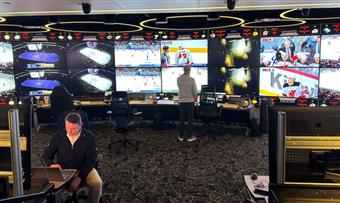
In Toronto sits one of the most consequential rooms in North American professional sports. The NHL's Situation Room is equal parts control center, safeguard, and nerve hub: a centralized replay and monitoring operation where every game, every goal, and every potential inflection point is scrutinized in real time.
Long a part of the sport's culture, the Situation Room has an entirely new look for the future. At the heart of the operation is a long-running technology partnership with Sony, anchored by Hawk-Eye Innovations imaging and replay systems.
The NHL's recently revamped Situation Room in Toronto is the nerve center for all things officiating and safety for the league during every game. (Photos: NHL, Sony)
Now in its second season in an upgraded space, the Situation Room represents a meaningful evolution in how the league applies technology - not just to officiating but to player safety, broadcast support, and future fan-facing experiences.
The system has grown with our league and our needs, says Sean Williams, VP, innovation and technology partnerships, NHL. It shows the power of not just Sony and Sony's Hawk-Eye system but all of the technology behind the scenes making the game come to life.
From Replay Reviews to a League-Wide HubThe NHL has relied on Sony's Hawk-Eye technology since 2015, when Synchronized Multi-Angle Replay Technology (SMART) services were first deployed across the league. What began as a replay-review solution has steadily expanded into a comprehensive infrastructure, with managed cameras now installed in all 32 arenas and feeds flowing directly into the Situation Room.
It started with just a handful of camera feeds, some coming from broadcasters, says Williams, and now it has grown significantly with our own managed cameras physically installed in the venue and feeding the Hawk-Eye system.
The NHL has worked with Sony's Hawk-Eye technology since 2015, when Synchronized Multi-Angle Replay Technology (SMART) services were first deployed across the league.
Each game is assigned a dedicated operator in Toronto, responsible for monitoring play, scrubbing through angles, and surfacing the exact frame required when a review or challenge arises. Those feeds - pulled from standardized goal-line, blue-line, and overhead camera positions - can be sent directly to the officials' iPads on the ice when a decision is under review.
For Kris King, EVP, hockey operations, NHL, staffing philosophy remains straightforward: every game deserves full attention. We generally will have one viewer assigned to each game, he says. There's just too much importance in every single game to be sharing those. It's their job to break that game down and let us know when we have to react - whether it's a review, a challenge, or something else we need to get involved in from Toronto.
On nights with lighter schedules, operators may handle two games sequentially, but never simultaneously. That's certainly not overlapping, King adds. Every game is covered.
The interface itself is intentionally streamlined. It's fairly easy to use, Williams points out. It's not a robust video-editing software. These individuals do it night in and night out, so they're very comfortable scrubbing back in time and switching between camera angles.
More Than Just OfficiatingWhile replay reviews are the most visible function, the Situation Room's responsibilities extend far beyond confirming goals or offsides calls. King describes it as the hub of the league, where the hockey-operations team monitors player safety, arena readiness, and logistical contingencies.
We're looking at the aspect of the game from all directions and player safety more than anything, he said. If a player gets injured, we're making sure the proper protocols are in place. If there are lighting issues or ice problems, we're helping get to the bottom of it so the game can continue.
The room also supports postgame-scoring accuracy. Hockey-operations staffers use the same Sony Hawk-Eye tools to review and, when necessary, correct goals and assists - a workflow made more efficient by higher-resolution cameras and improved access to angles.
There are a lot of different layers that go on within our department, King says. A lot of it centers outside that room.
Supporting Broadcasters With Context and ClarityThe Situation Room also plays a behind-the-scenes role in helping broadcasters tell the story accurately. When a goal is overturned or upheld, the league distributes a written explanation citing the applicable rule.
We'll blast out an explanation quoting the rule of why that decision was made, King says. It allows the media to understand why we stayed with the call on the ice or overruled it.
From the Situation Room, the NHL's Kris King (center) is able to help monitor all games going on throughout the league.
In some cases, broadcasters or teams follow up directly, prompting the league to pull archived clips from the Sony Hawk-Eye system to support those explanations. And, when NHL-owned cameras - such as those embedded in the crossbar - factor into a decision, those views can be routed back to the television compound for on-air use.
We are able to give some of our cameras specifically to broadcast to use if we use them to make our decision, King explains.
The Sony Hawk-Eye BackboneFrom Sony's perspective, the NHL deployment shares a common backbone with Sony Hawk-Eye systems used across other sports, b
North America Stories
03/03/2026
Beyond Sports, a Sony group company, and LIV Golf, the world's golf league, ...
03/03/2026
Ilitch Sports + Entertainment announces the launch of Detroit SportsNet (DSN), a year-round broadcast home for two of Detroit's franchises. With flexible op...
03/03/2026
Advanced Systems Group, LLC (ASG), a technology and services provider for media ...
03/03/2026
The PGA of America, NBC Sports and USA Sports extend their media rights agreemen...
03/03/2026
AI device ecosystem company HONOR enters into a strategic technical collaboratio...
03/03/2026
Cleveland's Telos Alliance, pioneers in broadcast technology for 30 years, l...
03/03/2026
The MD 9235 microphone head for wireless handhelds has been a firm favorite with many engineers and artists for its ability to cut through high on-stage levels ...
03/03/2026
Haivision Systems Inc. (Haivision), a global provider of mission-critical, real-...
03/03/2026
Broadcast Management Group (BMG) announces the expansion of its 62,000-square-fo...
03/03/2026
Maroon 5's musical tour in 2025 marked a leap forward in live audio as Monitor Engineer Dave Rupsch utilized Sennheiser's all-digital Spectera wireless ...
03/03/2026
Designed specifically for pro basketball, the renovated space at Gainbridge Fiel...
03/03/2026
As part of the move, former CEO Phillipp Lawo joins the broadcast-tech provider's Supervisory Board
Lawo has announced appointment of Jamie Dunn as chief e...
03/03/2026
A team of legendary announcers and analysts and a classic graphics look will bring the past to life
NBC Sports and Peacock will return to yesteryear for tonigh...
03/03/2026
From April 30 to May 3, Sundance Film Festival: CDMX 2026 will offer a selection of exciting independent cinema.
Mexico City, March 3, 2026 - At a moment of he...
03/03/2026
Nielsen's DMA data gives Magellan AI users a standardized way to measure th...
03/03/2026
Share
Copy link
Facebook
X
Linkedin
Bluesky
Email...
03/03/2026
Share
Copy link
Facebook
X
Linkedin
Bluesky
Email...
03/03/2026
Share
Copy link
Facebook
X
Linkedin
Bluesky
Email...
03/03/2026
Marshall Electronics premieres the CV356-10X, its latest compact 10X camera that offers Full HD with simultaneous SDI and HDMI outputs, at NAB 2026 (Booth C8339...
03/03/2026
farmerswife, the industry-leading enterprise operations platform for broadcast and post-production, today announced it will exhibit at NAB Show 2026 in Las Vega...
03/03/2026
Manfrotto has announced that the Manfrotto ONE Hybrid tripod has won the iF DESIGN AWARD 2026, one of the world's most respected design honours.
Selected ...
03/03/2026
DHD is expanding the capabilities of its DX2, RX2, SX2 and TX2 broadcast audio mixers, RM1 portable production unit and XC3/XD3/XS2 processing cores with the in...
03/03/2026
Leading video software provider Synamedia and MoMe, a leading Spanish consultancy and systems integrator, today announced the launch of Spain's first stream...
03/03/2026
Share
Copy link
Facebook
X
Linkedin
Bluesky
Email...
03/03/2026
Share
Copy link
Facebook
X
Linkedin
Bluesky
Email...
03/03/2026
Share
Copy link
Facebook
X
Linkedin
Bluesky
Email...
03/03/2026
Share
Copy link
Facebook
X
Linkedin
Bluesky
Email...
03/03/2026
Share
Copy link
Facebook
X
Linkedin
Bluesky
Email...
03/03/2026
Home Post Production has further expanded its factual, unscripted, and entertainment capabilities with the acquisition of Picture Shop Bristol, a leading post h...
03/03/2026
Share
Copy link
Facebook
X
Linkedin
Bluesky
Email...
03/03/2026
Share
Copy link
Facebook
X
Linkedin
Bluesky
Email...
03/03/2026
Share
Copy link
Facebook
X
Linkedin
Bluesky
Email...
03/03/2026
Share
Copy link
Facebook
X
Linkedin
Bluesky
Email...
03/03/2026
Share
Copy link
Facebook
X
Linkedin
Bluesky
Email...
03/03/2026
Share
Copy link
Facebook
X
Linkedin
Bluesky
Email...
03/03/2026
Back to All News
Kai Ko and Wang Po-chieh Unleash Divine Glory in Electrifying ...
03/03/2026
Back to All News
My Dearest Se orita, by Fernando Gonz lez Molina, Arrives on N...
03/03/2026
The Hollywood Professional Association (HPA) concluded the 2026 HPA Tech Retreat, convening more than 800 industry leaders, technologists, creatives and executi...
02/03/2026
NBC Sports selected Imaginary Forces to create the main title sequence for the M...
02/03/2026
The NFL announces the launch of the NFL Draft Innovation Challenge, a new crowds...
02/03/2026
The World Teleport Association (WTA) has named Skyline Communications' DataMiner SatOps solution as a finalist for the 2026 Teleport Technology of the Year ...
02/03/2026
Ventum Tech announces a strategic partnership with Pixotope, a real-time graphic...
02/03/2026
Victory , a free, ad-supported sports streaming service, announces the launch of...
02/03/2026
MELBOURNE, Fla., March 2, 2026 - L3Harris Technologies (NYSE: LHX) today announc...
02/03/2026
Harvey Norman tops New Zealand's biggest ad spenders as retail leads and telcos and beverages surge Auckland March 3, 2026 - Nielsen's New Zealand'...
02/03/2026
Advanced Systems Group, LLC (ASG), a technology and services provider for media creatives and content owners, has appointed Jody Boatwright as Chief Strategy Of...
02/03/2026
Lightware, an industry leader in signal management, is reinforcing its commitment to simplifying complex AV environments with the continued evolution of its TPN...
02/03/2026
ZEISS Cinema opens its doors to an exclusive screening, filmmakers Q&A and hands-on showcase of the new ZEISS Aatma lens family on Tuesday, March 10, 6:00-9:00 ...
02/03/2026
To expand the creative potential of the compact Astera QuikBeam, DoPchoice introduces the SNAPBAG Round. The new light-shaping accessory transforms the powerfu...
02/03/2026
Douglas Dubler
On a rooftop in New York City, veteran photographer Douglas Dubler watched the sun's angle shift across the urban landscape, his internal cl...














 NHL Situation Room 2.0: How Sony Hawk-Eye Powers Centralized Officiating, Player Safety, the League's Next ChapterThe league's video nerve center in Toronto received a substantial upgradeBy Brandon Costa, Director of Digital


