LA JOLLA, CA-Viruses are masters at invading our cells thanks to specialized proteins that coat their surfaces. When scientists design vaccines, they often create versions of these viral surface proteins to study how our immune systems might respond. But those lab-made proteins typically lack key parts that sit within the virus' membrane, so they don't always behave the way they would on a real virus. This has made it difficult to understand how antibodies actually identify and neutralize these viral targets.
Now, scientists at Scripps Research, in collaboration with IAVI and other institutes, have created a platform that allows viral surface proteins to be studied in a form that more closely resembles how they appear naturally. The new approach utilizes nanodisc technology where these proteins are embedded into particles made of lipid molecules, preserving them in a membrane-like structure. This could help guide vaccine research by better revealing how antibodies and viral proteins interact.
Outlined in Nature Communications on February 10, 2026, the platform was tested using proteins from HIV and Ebola: two viruses that have long challenged vaccine developers because their surface proteins are difficult for the immune system to target effectively. However, the approach could be applied broadly to other viruses with similar membrane-embedded proteins, such as influenza and SARS-CoV-2.
For many years, we've had to rely on versions of viral proteins that are missing important pieces, says co-senior author William Schief, a professor at Scripps Research and executive director of vaccine design at IAVI's Neutralizing Antibody Center. Our platform lets us study these proteins in a setting that better reflects their natural environment, which is critical if we want to understand how protective antibodies recognize a virus.
In real viruses, surface proteins aren't free-floating, but rather embedded in a lipid membrane and arranged in specific shapes. Yet most lab studies remove the membrane-anchoring region to make the proteins easier to produce and analyze. While useful, those shortcuts can obscure important features, particularly for antibodies that target regions near the base of the protein, close to the viral membrane.
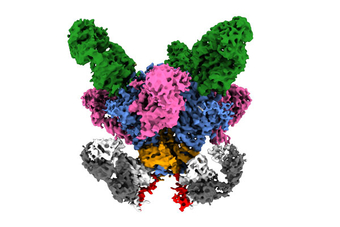
To address this, the research team assembled vaccine candidate viral proteins into nanodiscs, which are small and stable patches of membrane that hold the proteins in place. These lipid discs mimic the virus' outer layer, helping preserve how antibodies would identify proteins in an actual virus. Their novel platform allowed the researchers to use a range of standard vaccine-development tools, including tests of antibody binding, sorting of immune cells and high-resolution imaging.
Putting all of these components together into a single, reliable system was the key, says first author Kimmo Rantalainen, a senior scientist in Schief's lab. The individual pieces already existed, but making them work together in a way that's reproducible and scalable opens up new possibilities for how vaccines are analyzed and designed.
Using HIV as a test case, the team focused on a conserved region of the virus' surface protein that sits near the membrane. This region is targeted by a class of antibodies capable of blocking nearly all HIV variants. Such antibodies recognize viral parts that remain similar even as they mutate-an immune response scientists hope vaccines could eventually trigger.
With their nanodisc platform, the researchers were able to capture detailed structural snapshots of how these antibodies interact with the viral protein in its membrane context, revealing features that aren't visible when the protein is studied on its own. Those insights also help explain how certain antibodies may neutralize a virus by destabilizing the protein structures it uses to infect cells, offering clues for how future vaccines might better engage similar immune responses.
The structure gave us a level of detail we simply couldn't access before, notes Rantalainen. It showed us new interactions at the membrane interface and suggested why those matter for antibody function.
To demonstrate that the approach isn't limited to HIV, the team also applied their nanodisc platform to Ebola proteins, confirming that antibodies could identify and bind to these proteins in the same membrane-like environment.
Beyond structural studies, this platform can be used to analyze immune responses to vaccine candidates. By using the nanodiscs as molecular bait, researchers can isolate and study cells that recognize viral proteins, providing a clearer picture of how the body responds to a given vaccine candidate. And because the system is scalable, what once took a month or longer to prepare can now be done in about a week, making it practical for comparing multiple candidate designs side by side.
Although the platform isn't a vaccine itself, scientists can use it as a tool to inform and accelerate vaccine research, particularly for viruses where traditional approaches have fallen short.
This gives the field a more realistic, accurate way to test ideas early on, emphasizes Schief. By improving how we study viral proteins and antibody responses, we hope this platform will help advance next-generation vaccines against some of the world's most challenging viruses.
In addition to Schief and Rantalainen, authors of the study Virus glycoprotein nanodisc platform for vaccine analytics, include Alessia Liguori, Gabriel Ozorowski, Claudia Flynn, Jon M. Steichen, Olivia M. Swanson, Patrick J. Madden, Sabyasachi Baboo, Swastik Phulera, Anant Gharpure, Danny Lu, Oleksandr Kalyuzhniy, Patrick Skog, Sierra Terada, Monolina Shil, Jolene K. Diedrich, Erik Georgeson, Ryan Tingle, Saman Eskandarzadeh, Wen-Hsin Lee, Nushin Alavi, Diana Goodwin, Michael
Most recent headlines
05/01/2027
Worlds first 802.15.4ab-UWB chip verified by Calterah and Rohde & Schwarz to be ...
09/10/2026
September 10 2026, 06:00 (PDT) Dolby Expands Dolby OptiView Platform with New Capabilities at IBC 2026
New Sports Intelligence helps providers better unders...
07/10/2026
Dalet, a leading technology and service provider for media-rich organizations, today announced the latest Long-Term Supported (LTS) release of Dalet Flex. Build...
20/09/2026
Piano-playing singer-songwriter competition returns for fourth year
Casio have officially revealed the list of 16 finalists who have earned their place in t...
20/09/2026
COW Jobs: Video Editor, Motion Designer - Remote, PT, 6 Months
Brie Clayton September 20, 2026
0 Comments
Video Editor + Motion Designer (Remote | PT ...
19/09/2026
Three new rackmount power conditioners introduced
Yorkville Sound have announce the upcoming launch of three new RPC rackmount power conditioners from ART P...
19/09/2026
September 15, 2026
AMSTERDAM, SEPTEMBER 2026 - Colorfront (colorfront.com), the Academy and Emmy Award-winning developer of high-performance cinema mastering, ...
19/09/2026
Two High-Profile Professional Sports Franchises Renew creative.space Contracts with DigitalGlue
NFL team and Major League Soccer Club cite ease of use, secure ...
19/09/2026
Limited Edition Audio releases VoxSplit Pro for overlapping dialogue separation ...
18/09/2026
IBC 2026 Tech Moves Beyond the Gloss and Into the Rack If you spent any time in the halls of the RAI this year, you noticed a clear shift in conversation. The c...
18/09/2026
In-venue and creative video staffers at the professional and collegiate level ha...
18/09/2026
Qvest has appointed Jens Miedek as Senior Vice President Sales, Media and Entertainment. Before joining Qvest, Miedek spent 16 years at Riedel Communications an...
18/09/2026
Fonn Group has acquired full ownership of everviz, a cloud-native platform for interactive charts, maps, and data-driven graphics, and will rebrand it as Teikna...
18/09/2026
Other World Computing (OWC) has announced the acquisition of OpenDrives, a provider of software-defined video and rich media storage management solutions. The a...
18/09/2026
Kaltura and Verimatrix have announced a partnership integrating Verimatrix's Digital Rights Management and security capabilities into Kaltura's Cloud TV...
18/09/2026
The sixth edition of the World Nomad Games combined traditional sports, large-scale cultural performances, and some decidedly modern broadcast technology. Held ...
18/09/2026
DAZN and Super League Basketball (SLB) have extended their partnership for the 2026-27 season. Every Championship, Cup, and Play-Off fixture will be available l...
18/09/2026
Nielsen has announced that its Streaming Content Ratings (SCR) product will move from weekly to daily data delivery, with clients now receiving viewership data ...
18/09/2026
ESPN will present LALIGA's ElCl sico on ABC for the first time, with FC Barcelona vs. Real Madrid airing Sunday, October 25 at 4 p.m. ET. A one-hour pre-mat...
18/09/2026
The University of Pennsylvania's Division of Recreation and Intercollegiate ...
18/09/2026
The Charlotte Hornets have announced DAZN as their exclusive direct-to-consumer streaming partner for the 2026-27 NBA season. The service launches immediately, ...
18/09/2026
Broadcast sports' original medium will let drivers keep on hearing the plays thanks to a new bill set to pass the Senate....
18/09/2026
Fourteen iPhone 18 Pro devices - eight connected over a T-Mobile Private 5G Netw...
18/09/2026
The Minnesota Lynx have announced that their final local broadcast of the 2026 regular season will air free on FOX 9 following the shutdown of Victory . The Ly...
18/09/2026
Monumental Sports Network (MNMT) has announced that its Monumental+ streaming service is now available as a subscription through Prime Video, giving Capitals an...
18/09/2026
WTGL, the women's team golf league created by TMRW Sports in partnership with the LPGA, has announced its inaugural season schedule. The season premieres Su...
18/09/2026
Ratings Roundup is a rundown of recent ratings news and is derived from press re...
18/09/2026
Studio Network Solutions (SNS) has won Best Journal Article at the 2026 IAMT Impact Awards for What Video Editors Need When Everything Is Changing Around Them, ...
18/09/2026
10 new voice models join line-up
The latest expansion for IK Multimedia's AI-powered vocal-modelling software has arrived, delivering a set of 10 new vo...
18/09/2026
A day of hands-on synthesis, sound design & performance
On Saturday 26 September 2026, The Museum of Synthesisers will be hosting a full day of hands-on syn...
18/09/2026
HPA is supporting Fix It or Risk It, a non-commercial, industry-wide public-service campaign helping organizations across the media and entertainment supply cha...
18/09/2026
AgileTV has successfully wrapped up its participation at IBC 2026 in Amsterdam, following four days of conversations with customers, partners and industry profe...
18/09/2026
aconnic AG (ISIN: DE000A0LBKW6), Munich, invites its shareholders and investors to a Virtual Investor Conference on Tuesday, September 29th, 2026, at 11.00 am.
...
18/09/2026
DHD reports a high level of interest in its range of audio production equipment on all four days of the September 11-14 International Broadcasting Convention in...
18/09/2026
Sonnet Announces Thunderbolt 5 eGPU With 850-Watt Power Supply and Integrated Do...
18/09/2026
DeckBridge adds live Resolve playback and Fairlight controls to Stream Deck
Brie Clayton September 17, 2026
0 Comments
DeckBridge starting profiles ac...
18/09/2026
Learn to arrange tracks using Color With Live's Free Stencil Pack
Brie Clayton September 17, 2026
0 Comments
Stencils are Color With Live's or...
18/09/2026
Berklee Establishes Susan Tedeschi Scholarship in Honor of Grammy-Winning Alumna The scholarship is announced as Tedeschi returns to headline the Berklee Bloc...
18/09/2026
The inside scoop on attention-grabbing market assets from those in the know 17 September 2026
(L-R): Sophie Green, Todd Brown and Edwina Waddy
Find this episo...
18/09/2026
Senior Colorist Siggy Ferstl of Company 3 has been grading The Boys since the sh...
18/09/2026
Friday 18 September 2026
The new iPhone 18 Pro, iPhone 18 Pro Max, Apple Watch ...
18/09/2026
Senior Colorist Siggy Ferstl of Company 3 has been grading The Boys since the sh...
17/09/2026
Lions vs. Bills will also be the first regular-season game at new Highmark Stadi...
17/09/2026
Teradek has announced Bolt 7, a wireless video and data system that adds an integrated 900MHz radio to the Bolt's zero-delay video pipeline. The 900MHz chan...
17/09/2026
DAZN has announced three appointments to its executive leadership team, all reporting to CEO Shay Segev effective immediately.
Patrick Delany has been appointe...
17/09/2026
Monumental Sports and Entertainment (MSE) has announced a leadership restructuring. Zach Leonsis has been named President and Vice Chairman, a newly created pos...
17/09/2026
CP Communications has been named Best of Florida for Audio-Visual Services, and its subsidiary Red House Streaming has been named Best Movie and Recording Studi...
17/09/2026
Scripps Sports and ION have announced a broadcast partnership for the Shriners Children's East-West Bowl, the nation's oldest college all-star football ...
17/09/2026
The 17th annual espnW: Women + Sports Summit, presented by Toyota, will take place October 14-16 at the Ojai Valley Inn in Ojai, California, with virtual attend...
17/09/2026
The Professional Audio Manufacturers Alliance (PAMA) and Shure Incorporated have...














 LA JOLLA, CA-Viruses are masters at invading our cells thanks to specialized proteins that coat their surfaces. When scientists design vaccines, they often create versions of these viral surface proteins to study how our immune systems might respond. But those lab-made proteins typically lack key parts that sit within the virus' membrane, so they don't always behave the way they would on a real virus. This has made it difficult to understand how antibodies actually identify and neutralize these viral targets.


